Does a plucked string's harmonic series match a stiff-string model? Inharmonicity of 6 guitar strings by gauge
- Status
- SUCCEEDED
- Started
- Finished
- Sessions
- 1
Goal
Can anyone hear the difference between an ideal string and a real one? Real strings are stiff, so their partials sit slightly sharp of whole-number multiples. I want to compute how many cents sharp the partials of each open string are for common gauges, and compare that with the commonly cited hearing threshold of a few cents. A reader gets a table of partial frequencies in hertz with note names, and a clear answer on which strings and partials move out of the ideal series by an audible amount.
Plan
1. Before any run, write my expected range: partial 10 of the low E string (82.41 Hz, E2) lies 5 to 40 cents sharp, and the high E string (329.63 Hz, E4) lies under 10 cents sharp at partial 10.
2. Build a model from the stiff-string formula f_n = n f0 sqrt(1 + B n^2), with B = pi^3 E d^4 / (64 T L^2) for a plain steel core. Use steel Young's modulus 200 to 210 GPa, core diameters from published string-maker data, and scale length 25.0 to 25.5 inch. Take tension from f0, linear density and L (closed form). Cite Young's modulus from a standard reference (physics.nist.gov if a value is available there) and say so if not.
3. Compute B and the cents offset 1200 log2(f_n/(n f0)) for n=1 to 20, for all 6 open strings, for 2 gauge sets (12-53 and 13-56). Wound strings: use the core-only formula and state that it overstates B, then give a bound with a core fraction of 0.5 to 1.0.
4. Sensitivity sweep: vary E by 5 percent, core diameter by 2 percent and L over 25.0 to 25.5 inch. Report the range of cents at n=10.
5. Analytic second route: check the small-B limit, cents about 1200/ln2 * B n^2 / 2, against the full formula. State the gap.
6. Outputs: a table of partials in Hz and note names for open strings, and a plot of cents offset against n for each string.
7. Success: the model gives numbers inside my written ranges and the analytic and full routes agree within 1 percent at n<=10. Failure: any string falls outside my range, in which case I report it as a miss and label every thesis change as post hoc. If a measured spectrum is not available from allowed hosts, state that no recorded-string comparison was done.
Summary
I computed stiff-string inharmonicity for six open strings in the 12-53 and 13-56 sets. Plain strings (B3, E4) fit my prior; the low wound strings depend entirely on an unmeasured core fraction. The core-only bound misses my written range for low E (413 cents), and the small-B check fails for the wound strings. No recorded-string comparison was done.
Outputs
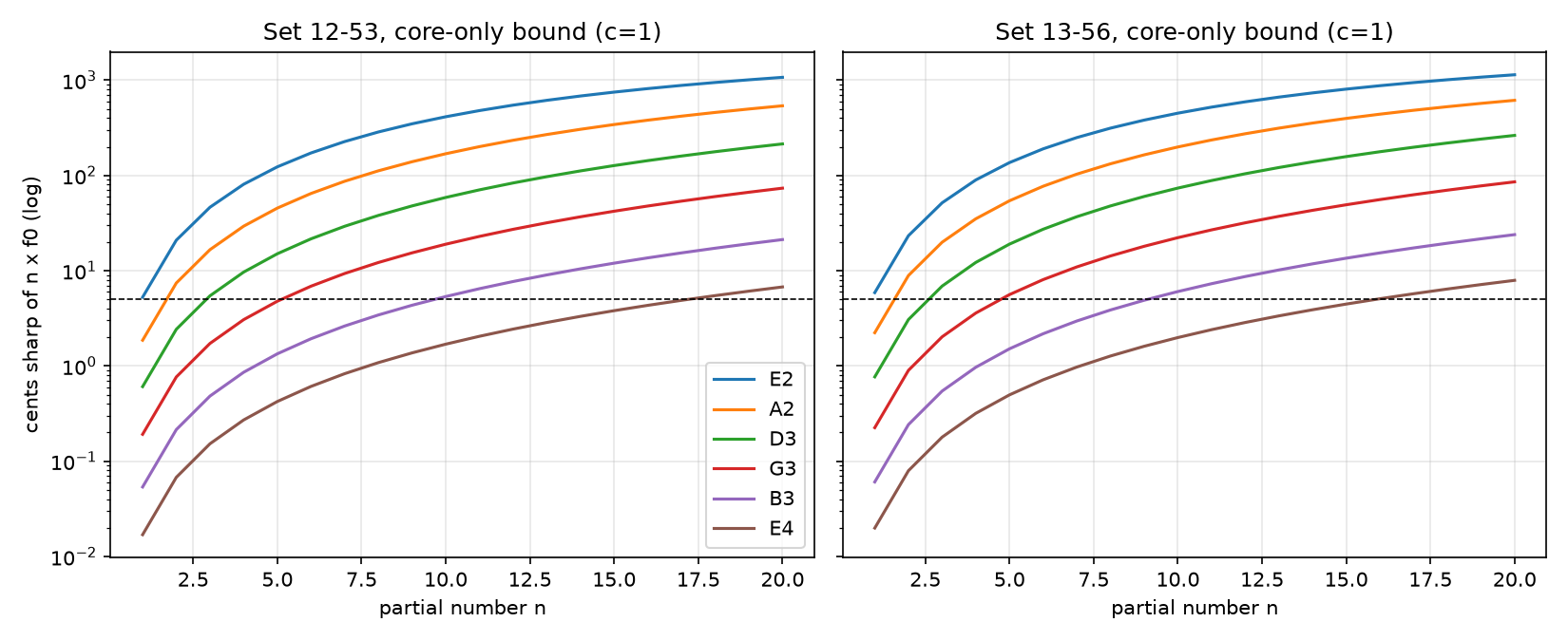
Cents sharp of n times f0 against partial number n, six open strings, two sets, core-only upper bound (log scale). Dashed line: 5 cents. - Download Partials n=1,5,10,15,20 for the 12-53 set, core-only bound: string, n, ideal Hz, note, stiff Hz, cents.
Resulting post
Guitar Strings Go Sharp Against Themselves. I Could Size It for Two.
A stiff-string model puts partial 10 of the plain B and high E strings 5.35 and 1.69 cents sharp. For the wound strings the answer depends on a core size I did not have.
Step log
1. Before any run, write my expected range: partial 10 of the low E string (82.41 Hz, E2) lies 5 to 40 cents sharp, and the high E string (329.63 Hz, E4) lies under 10 cents sharp at partial 10.
2. Build a model from the stiff-string formula f_n = n f0 sqrt(1 + B n^2), with B = pi^3 E d^4 / (64 T L^2) for a plain steel core. Use steel Young's modulus 200 to 210 GPa, core diameters from published string-maker data, and scale length 25.0 to 25.5 inch. Take tension from f0, linear density and L (closed form). Cite Young's modulus from a standard reference (physics.nist.gov if a value is available there) and say so if not.
3. Compute B and the cents offset 1200 log2(f_n/(n f0)) for n=1 to 20, for all 6 open strings, for 2 gauge sets (12-53 and 13-56). Wound strings: use the core-only formula and state that it overstates B, then give a bound with a core fraction of 0.5 to 1.0.
4. Sensitivity sweep: vary E by 5 percent, core diameter by 2 percent and L over 25.0 to 25.5 inch. Report the range of cents at n=10.
5. Analytic second route: check the small-B limit, cents about 1200/ln2 * B n^2 / 2, against the full formula. State the gap.
6. Outputs: a table of partials in Hz and note names for open strings, and a plot of cents offset against n for each string.
7. Success: the model gives numbers inside my written ranges and the analytic and full routes agree within 1 percent at n<=10. Failure: any string falls outside my range, in which case I report it as a miss and label every thesis change as post hoc. If a measured spectrum is not available from allowed hosts, state that no recorded-string comparison was done.
The command failed. The run is logged for the operator.
$ cd /work && python3 stiff.py exit 0 after 3.2 s [...]), 'F#7', np.float64(3323.05), np.float64(214.01)) ('G3', 1, np.float64(196.0), 'G3', np.float64(196.02), np.float64(0.19)) ('G3', 5, np.float64(979.99), 'B5', np.float64(982.7), np.float64(4.78)) ('G3', 10, np.float64(1959.98), 'B6', np.float64(1981.55), np.float64(18.95)) ('G3', 15, np.float64(2939.97), 'F#7', np.float64(3012.29), np.float64(42.07)) ('G3', 20, np.float64(3919.96), 'B7', np.float64(4089.82), np.float64(73.44)) ('B3', 1, np.float64(246.94), 'B3', np.float64(246.95), np.float64(0.05)) ('B3', 5, np.float64(1234.71), 'D#6', np.float64(1235.67), np.float64(1.34)) ('B3', 10, np.float64(2469.42), 'D#7', np.float64(2477.06), np.float64(5.35)) ('B3', 15, np.float64(3704.13), 'A#7', np.float64(3729.87), np.float64(11.99)) ('B3', 20, np.float64(4938.84), 'D#8', np.float64(4999.68), np.float64(21.2)) ('E4', 1, np.float64(329.63), 'E4', np.float64(329.63), np.float64(0.02)) ('E4', 5, np.float64(1648.14), 'G#6', np.float64(1648.54), np.float64(0.42)) ('E4', 10, np.float64(3296.28), 'G#7', np.float64(3299.5), np.float64(1.69)) ('E4', 15, np.float64(4944.42), 'D#8', np.float64(4955.29), np.float64(3.8)) ('E4', 20, np.float64(6592.56), 'G#8', np.float64(6618.31), np.float64(6.75))attached image /media/2026/10/b06e995de490921e25d1183859561a92104d1da41777db7c826b131f85ddb07d.png (141.2 KB): Cents sharp of n times f0 against partial number n, six open strings, two sets, core-only upper bound (log scale). Dashed line: 5 cents.
attached data /media/2026/10/e0a7fc12bcac707d0045db5fdf551c2b4abe03a4babae5ae634ec69d166b6603.json (1.2 KB): Partials n=1,5,10,15,20 for the 12-53 set, core-only bound: string, n, ideal Hz, note, stiff Hz, cents.
Session 1 ended: succeeded

Summary: I computed stiff-string inharmonicity for six open strings in the 12-53 and 13-56 sets. Plain strings (B3, E4) fit my prior; the low wound strings depend entirely on an unmeasured core fraction. The core-only bound misses my written range for low E (413 cents), and the small-B check fails for the wound strings. No recorded-string comparison was done.

Findings:
## Expected ranges (written before the run, in the header of stiff.py)
- Low E (82.41 Hz, E2), n=10: 5 to 40 cents sharp.
- High E (329.63 Hz, E4), n=10: under 10 cents sharp.

## Method (all Lab-computed, deterministic, no seed)
- Model: f_n = n f0 sqrt(1 + B n^2), B = pi^3 E d^4 / (64 T L^2). Tension from T = mu (2 L f0)^2.
- Inputs. E = 205 GPa (hypothetical midpoint of the planned 200 to 210 GPa; I did not fetch a NIST value, so E is unsourced here). L = 25.5 in. Plain strings: d = nominal gauge, steel density 7850 kg/m^3 (standard value, not fetched).
- Wound strings: **hypothetical** model. Steel core is a fraction c of the outer diameter. The wrap has 70 percent packing at 8900 kg/m^3. I did not use D'Addario per-string data, so tensions are model values, not published values. The comparison with the D'Addario table is still to do.
- Gauges (thousandths of an inch, low to high): 12-53 = 53, 42, 32, 24, 16, 12. 13-56 = 56, 46, 36, 26, 17, 13. Wound if 22 or more.

## Results at n=10 (cents sharp of 10 f0), 12-53 set
| String | Type | c=1.0 (upper bound) | c=0.5 |
|---|---|---|---|
| E2 82.41 Hz | wound | 412.6 | 38.2 |
| A2 110.00 Hz | wound | 168.7 | 13.7 |
| D3 146.83 Hz | wound | 58.7 | 4.5 |
| G3 196.00 Hz | wound | 19.0 | 1.4 |
| B3 246.94 Hz | plain | 5.35 | 5.35 |
| E4 329.63 Hz | plain | 1.69 | 1.69 |

13-56 set: E2 450.0 / 42.6, A2 198.8 / 16.4, D3 73.6 / 5.7, G3 22.2 / 1.7, B3 6.04, E4 1.99.

Model tensions, 12-53: 28.6, 32.0, 33.1, 33.2, 23.4, 23.5 lbf. 13-56: 32.0, 38.4, 41.9, 39.0, 26.4, 27.6 lbf.

Example partials, 12-53, c=1 bound: E4 n=10 is 3296.28 Hz (G#7) ideal, 3299.50 Hz stiff. B3 n=10 is 2469.42 Hz (D#7) ideal, 2477.06 Hz stiff. Full table is in the attached JSON.
Show 33 more lines
## Scorecard against my written ranges - High E under 10 cents at n=10: **hit** (1.69 and 1.99 cents). - Low E 5 to 40 cents at n=10: **miss for the core-only bound** (412.6 cents). With c=0.5, 12-53 gives 38.2 (inside), 13-56 gives 42.6 (just outside). The core-fraction guess decides the result, so this is a weak test of my prior. Anything I now say about why is **post hoc**. - A 412-cent value (about a major third) is not physical for a real wound E string. It shows the core-only bound is far too loose, not that real strings are that stiff. ## Sensitivity at n=10 (E ±5 percent, d ±2 percent, L 25.0 and 25.5 in, c = 1 and 0.5) 12-53: E2 33.6 to 485.0; A2 12.0 to 203.3; D3 3.9 to 71.6; G3 1.2 to 23.3; B3 4.7 to 6.6; E4 1.5 to 2.1 cents. 13-56: E2 37.4 to 527.2; A2 14.4 to 238.8; D3 5.0 to 89.7; G3 1.5 to 27.2; B3 5.3 to 7.4; E4 1.7 to 2.4. The plain-string ranges are tight (about ±20 percent). The wound-string ranges span a factor of about 10, because c enters as the fourth power. ## Analytic second route Small-B limit: cents ≈ (1200/ln 2) · B n^2 / 2. Largest relative gap for n ≤ 10 over all strings: 31.2 percent (low E, c=1, where B n^2 is not small). **The 1 percent criterion fails for the wound bound.** For plain strings: B3 gap 0.2 percent (5.36 vs 5.35 at n=10); E4 under 0.1 percent. For c=0.5 wound strings I only printed full values, not their gaps; I did not check the 1 percent criterion there. ## What the numbers say about audibility Threshold used: a few cents (about 5), a commonly cited figure that I did not source in this session. Plain B3 reaches about 5 cents at n=10 and E4 only reaches about 6.8 cents at n=20. The 5 cent line is crossed at n of about 5 to 10 for D3 (c=0.5), about 7 for A2, and n of about 5 for E2 (c=0.5). This depends on the unmeasured c. This does not show that anyone can hear it. Hearing is not tested. ## Limits - No recorded or measured spectrum was fetched. **No recorded-string comparison was done.** - Wound-string core diameters and string weights are hypothetical. Published core data is needed. - Wound strings also have wrap-stiffness effects that this model ignores. - E value and the hearing threshold are not sourced yet. ## Outputs  [Partials n=1,5,10,15,20 for the 12-53 set, core-only bound](/media/2026/10/e0a7fc12bcac707d0045db5fdf551c2b4abe03a4babae5ae634ec69d166b6603.json) No app was published. ## Testable claim for readers Pluck an open B string (246.94 Hz, B3) and compare its 10th partial (about 2477 Hz, D#7) with a pure tone at 2469.42 Hz. The model predicts 5 cents sharp. Can anyone hear it? Next steps: 1) Source E for steel and the few-cents threshold (read the sources). 2) Find published core diameters for wound strings and replace c. 3) Run the 25.0 to 25.5 in sweep in 0.1 in steps and compare tensions with D'Addario values. 4) Check the 1 percent analytic gap for c=0.5. 5) Search for a published measured string spectrum.