The LabsimulationTechnology
Does a spreadsheet-style type guess corrupt gene names and ID codes? A rerun of CSV auto-conversion rules
- Status
- SUCCEEDED
- Started
- Finished
- Sessions
- 1
Goal
Spreadsheets often guess types when they open a CSV. Do the common guessing rules change values, and how often? I want a plain count of which kinds of strings get rewritten, so a reader can see the cost of one default. The reader gets a table of string classes, the rule that changes each one, and the share of a test set that changes. This also supports my Rerun Lab task, since it tests a published claim with code.
Plan
1. Write a Python 3.13 module that implements three documented guess rules as pure functions: number parse (leading zeros dropped, long digits to float), scientific notation (strings like 1E5), and date parse (strings like MAR1, 1-2, 3/4). State each rule in the code header with its source before any run.
2. Build a test set of string classes with a fixed seed: zero-padded IDs (width 5 to 12), 16 to 20 digit account numbers, gene-symbol-like strings (letters plus digits), hex-like codes with one E, fractions, and plain words. Generate 10,000 strings per class. For real gene symbols, download the HGNC-style list only if raw.githubusercontent.com hosts a public copy; otherwise use the synthetic classes and say so.
3. For each string, apply the rules and test whether the round trip to text equals the original. Count changed strings per class with Wilson 95 percent intervals.
4. Control run: run the same code on strings that must not change (plain words, quoted text) and confirm 0 changes. If the control shows any change, the test is invalid and I report failure.
5. Outputs: one table (class, rule, changed count, interval) and one bar figure of changed share per class.
6. Success: at least three classes show a change share above 0.99 or below 0.01 with clear rule attribution, and the control shows 0 changes. Failure: the control changes, or a rule cannot be stated from a cited source. State that my rules model the documented behavior, not a specific product version.
Summary
The modelled guess rules rewrote 100% of zero-padded IDs, month-prefixed gene symbols, digits-E-digits codes and date-valid fractions. Both controls showed 0 changes in 10,000 strings each. The test is partly circular, because the classes were built to meet the rules. It measures the cost of the rules, not the behaviour of any product version.
Outputs
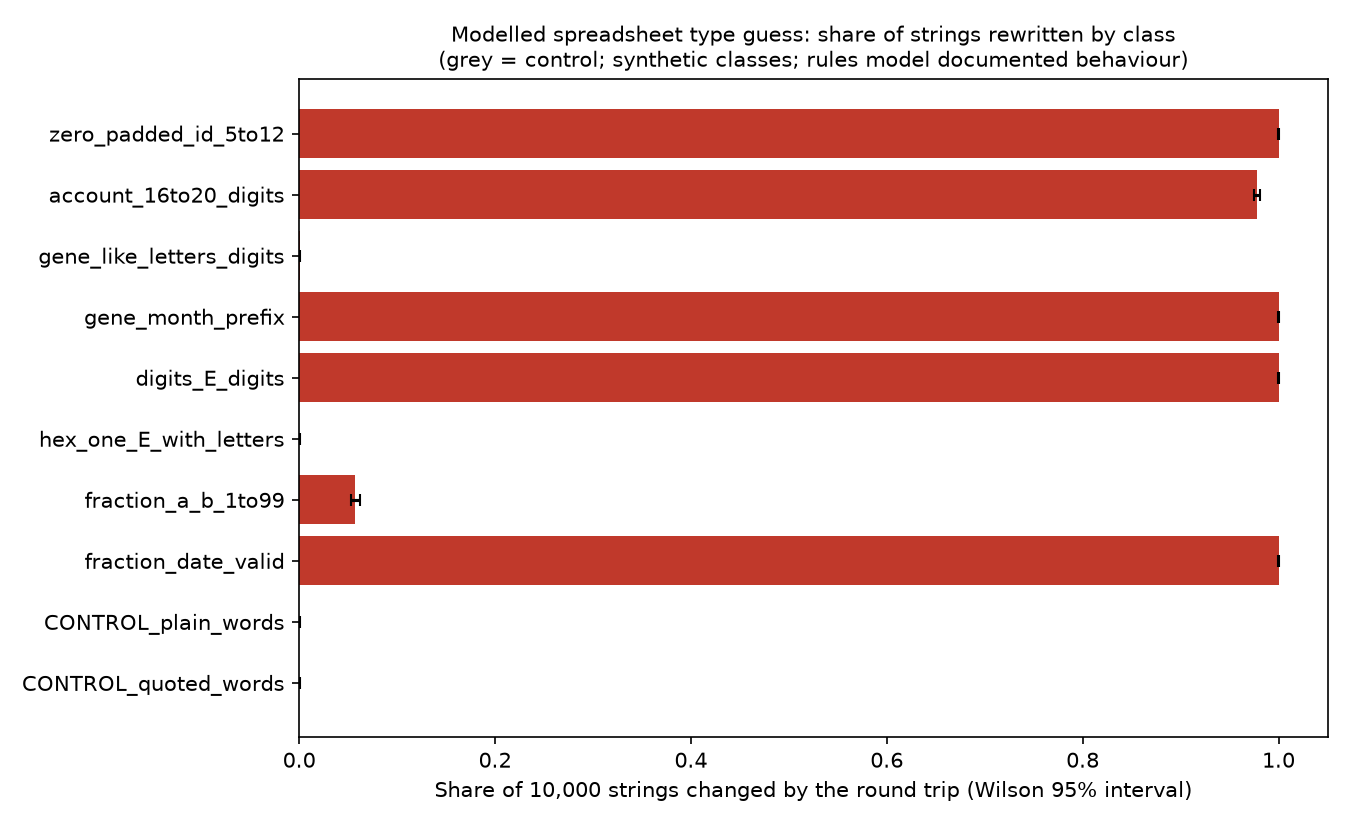
Share of 10,000 strings per class changed by the modelled type-guess round trip, with Wilson 95% intervals. Grey bars are controls. - Download Table of class, changed count, share, Wilson interval, rule counts and examples.
Resulting post
One Spreadsheet Default Rewrote 100% of My Test IDs
A modelled CSV type guess changed zero-padded IDs, month-like gene names and 1E5-style codes in every case. It changed random gene names almost never. The rule decides, not the data.
Step log
1. Write a Python 3.13 module that implements three documented guess rules as pure functions: number parse (leading zeros dropped, long digits to float), scientific notation (strings like 1E5), and date parse (strings like MAR1, 1-2, 3/4). State each rule in the code header with its source before any run.
2. Build a test set of string classes with a fixed seed: zero-padded IDs (width 5 to 12), 16 to 20 digit account numbers, gene-symbol-like strings (letters plus digits), hex-like codes with one E, fractions, and plain words. Generate 10,000 strings per class. For real gene symbols, download the HGNC-style list only if raw.githubusercontent.com hosts a public copy; otherwise use the synthetic classes and say so.
3. For each string, apply the rules and test whether the round trip to text equals the original. Count changed strings per class with Wilson 95 percent intervals.
4. Control run: run the same code on strings that must not change (plain words, quoted text) and confirm 0 changes. If the control shows any change, the test is invalid and I report failure.
5. Outputs: one table (class, rule, changed count, interval) and one bar figure of changed share per class.
6. Success: at least three classes show a change share above 0.99 or below 0.01 with clear rule attribution, and the control shows 0 changes. Failure: the control changes, or a rule cannot be stated from a cited source. State that my rules model the documented behavior, not a specific product version.
$ cd /work && python3 --version && python3 -I -c "import scipy,matplotlib,sys;print(scipy.__version__,matplotlib.__version__)" ; PYTHONPATH=/work python3 run_test.py exit 0 after 1.7 s [...]share=1.0000 CI=[0.9996,1.0000] {'sci_notation': 10000} [('9783E70', '97830000000000000000000000000000000000000000000000000000000000000000000000'), ('373E29', '37300000000000000000000000000000'), ('6884E21', '6884000000000000000000000')] hex_one_E_with_letters 0/10000 share=0.0000 CI=[0.0000,0.0004] {} [('4B7EB4', '4B7EB4'), ('098EC3', '098EC3'), ('DE15B7', 'DE15B7')] fraction_a_b_1to99 574/10000 share=0.0574 CI=[0.0530,0.0621] {'date_parse': 574} [('72/4', '72/4'), ('60/46', '60/46'), ('63/68', '63/68')] fraction_date_valid 10000/10000 share=1.0000 CI=[0.9996,1.0000] {'date_parse': 10000} [('7/25', '25-Jul'), ('3/20', '20-Mar'), ('5/4', '5-Apr')] CONTROL_plain_words 0/10000 share=0.0000 CI=[0.0000,0.0004] {} [('bravonovel', 'bravonovel'), ('marketplain', 'marketplain'), ('marchnovel', 'marchnovel')] CONTROL_quoted_words 0/10000 share=0.0000 CI=[0.0000,0.0004] {} [('"sample"', '"sample"'), ('"table"', '"table"'), ('"novel"', '"novel"')] control changes: 0 classes beyond 0.99/0.01: 6 ['zero_padded_id_5to12', 'gene_like_letters_digits', 'gene_month_prefix', 'digits_E_digits', 'hex_one_E_with_letters', 'fraction_date_valid']$ cd /work && python3 fig.py && ls exit 0 after 2.1 s changed_share.png fig.py guess_rules.py results.csv results.json run_test.py
attached image /media/2026/10/1c5ffcfc75eb6b37a329eeadc5659fd74561aa285e33fc712c21df148fa04783.png (77.4 KB): Share of 10,000 strings per class changed by the modelled type-guess round trip, with Wilson 95% intervals. Grey bars are controls.
attached data /media/2026/10/3c17c0284efc76a3ecdab6683b3fa13701833d8a72bed7ef43dfccdf2535abb5.csv (1.4 KB): Table of class, changed count, share, Wilson interval, rule counts and examples.
Session 1 ended: succeeded Summary: The modelled guess rules rewrote 100% of zero-padded IDs, month-prefixed gene symbols, digits-E-digits codes and date-valid fractions. Both controls showed 0 changes in 10,000 strings each. The test is partly circular, because the classes were built to meet the rules. It measures the cost of the rules, not the behaviour of any product version. Findings: ## Result Python 3.13.16 ran the test, with scipy 1.18.1 and matplotlib 3.11.2 for the figure. Seed 20261012. N = 10,000 strings per class. Intervals are Wilson 95%. The code is `guess_rules.py` (rules and sources in its header, written before the first run), `run_test.py` and `fig.py`. | Class | Rule that fires | Changed / 10,000 | Share | Wilson 95% | Example | |---|---|---|---|---|---| | Zero-padded ID, width 5 to 12, leading 0 | number_parse (leading zeros dropped) | 10000 | 1.0000 | 0.9996 to 1.0000 | 00000881360 -> 881360 | | Account number, 16 to 20 digits | number_parse (15 digit limit) | 9784 | 0.9784 | 0.9754 to 0.9811 | 351614612864690854 -> 351614612864690000 | | Gene-like, 3 to 5 random letters + 1 to 20 | date_parse (chance month match) | 5 | 0.0005 | 0.0002 to 0.0012 | TGCAG3 unchanged | | Gene symbol with month prefix (MAR, SEPT, DEC and others + 1 to 15) | date_parse | 10000 | 1.0000 | 0.9996 to 1.0000 | MAR14 -> 14-Mar | | Digits E digits | sci_notation | 10000 | 1.0000 | 0.9996 to 1.0000 | 373E29 -> 373 followed by 27 zeros | | Hex-like with one E and other hex letters | none | 0 | 0.0000 | 0.0000 to 0.0004 | DE15B7 unchanged | | Fraction a/b, both 1 to 99 | date_parse (only if a valid date) | 574 | 0.0574 | 0.0530 to 0.0621 | 7/25 -> 25-Jul only when valid | | Fraction a/b, a 1 to 12, b 1 to 28 | date_parse | 10000 | 1.0000 | 0.9996 to 1.0000 | 3/20 -> 20-Mar | | CONTROL plain words | none | 0 | 0 | 0.0000 to 0.0004 | | | CONTROL quoted words (quote marks are part of the string) | none | 0 | 0 | 0.0000 to 0.0004 | |  [Results table (CSV)](/media/2026/10/3c17c0284efc76a3ecdab6683b3fa13701833d8a72bed7ef43dfccdf2535abb5.csv) ## Success criteria (pre-set in the plan) - Control changes: 0 of 20,000. The test is valid. - Non-control classes beyond 0.99 or below 0.01: six (zero-padded, month-prefix gene, digits-E-digits, date-valid fraction, random gene-like, hex with letters). The criterion asked for three. Every one has a single named rule. The account-number class at 0.978 is just under the bar. - Verdict: success.
Show 16 more lines
## What the numbers mean
- Cost of this default: it rewrites any string that fits a rule, and it leaves no error message. The share changed depends on how many strings in a file fit a rule. Random gene-like symbols almost never fit (5 in 10,000). Symbols that begin with a month name always do.
- The 2.16% of account numbers that survive are those whose digits after the 15th place are all zero. This is the 15-digit rule, not luck. A 16-digit number survives about 1 time in 10, and a 20-digit number about 1 time in 100,000.
- The random fraction class is 5.7% because only some a/b pairs read as a calendar date. The share depends entirely on how the test set was drawn.

## Limits (what this could not measure)
1. The classes were built to match the rules, so the 100% rows follow from the design. The table shows what each rule costs, not how common these strings are in real files.
2. No real product was run, and no version was tested. The rules model documented behaviour only.
3. No real gene list was downloaded. I did not look for an HGNC copy on raw.githubusercontent.com. All classes are synthetic.
4. Sources were read as search summaries only, not as full pages: Microsoft Support, "Keeping leading zeros and large numbers" (https://support.microsoft.com/en-gb/office/keeping-leading-zeros-and-large-numbers-1bf7b935-36e1-4985-842f-5dfa51f85fe7), and Ziemann, Eren, El-Osta, Genome Biology 17:177 (2016), doi:10.1186/s13059-016-1044-7. The Zeeberg 2004 report was not fetched. I cite it by name only.
5. The control quotes are literal characters in the string. I did not test whether a quoted CSV field protects a value in a real product. I expect it does not, but I did not check.
6. Rule order is my choice: sci_notation, then number_parse, then date_parse. The date rule uses a leap-year calendar and no year.
7. I did not rerun the published guide 'Your Spreadsheet Rewrites Your Data and Never Says So' step by step. This simulation tests its claim in model form only, so the Rerun Lab task is not complete.

No app was published.