Weak acid pH from first principles: when does the sqrt(Ka*C) shortcut fail for food acids?
- Status
- SUCCEEDED
- Started
- Finished
- Sessions
- 2
Goal
Textbooks say pH of a weak acid is about half of (pKa minus log C). When is that shortcut wrong by more than 0.05 pH units? I want to find the exact boundary in pKa and concentration, using the full charge balance with water autoionization. Food acids such as acetic, citric and lactic sit near that boundary at low concentration. A reader gets one map of error, a table of checked pKa values for common food acids, and a clear rule for when the shortcut is safe. The mechanism is simple: the acid dissociates, and water supplies H+ when the acid is weak or dilute.
Plan
1. Data: download the NIST Chemistry WebBook or physics.nist.gov pages only if a pKa table is available there. If not, use pKa values from the CRC Handbook that I cite exactly by table name, and mark each value as a cited reference value, not a measurement. Use acetic (4.76), formic (3.75), lactic (3.86), benzoic (4.20), and the first step of citric (3.13), with 25 C stated.
2. Method: in Python with numpy and scipy, solve the exact charge balance [H+] = Ka*C/(Ka+[H+]) + Kw/[H+] with brentq over a grid of pKa from 2 to 10 and log10 C from -7 to 0. Compare with the shortcut pH = 0.5*(pKa - log10 C) and with the quadratic solution that ignores water.
3. Outputs: a heat map of pH error for the shortcut, with the 0.05 pH contour; a second map for the quadratic form; a table of the five food acids at 0.001, 0.01 and 0.1 mol/L with exact pH and error.
4. Check: confirm that the exact solver gives pH 7.00 for a strong-acid limit of 1e-7 mol/L HCl-like input near 6.79, and the known 0.1 mol/L acetic acid pH near 2.88. Compare the numbers with a textbook worked example that I cite.
5. Success: the 0.05 contour is found and matches the analytic condition (alpha less than about 0.05 for the quadratic step, and Ka*C much larger than Kw for the water step). Failure: the solver disagrees with the check values by more than 0.01 pH, or the boundary does not follow the analytic condition. I will report either result.
6. Writeup: state that all results are computed, not measured, and that activity coefficients are ignored. Report the ionic-strength error as a limit, with a rough Debye-Huckel estimate at 0.1 mol/L.
Summary
The exact charge-balance solver passes both check values. The 0.05 pH boundary for the shortcut follows alpha = 0.206 (about 21% dissociated) for pKa up to about 6. For pKa 8 and above, the water term sets the limit. I checked four of five pKa values against one open table (Harvey, from Martell and Smith). I did not read the CRC Handbook, and lactic acid is still unverified in a primary table.
Outputs
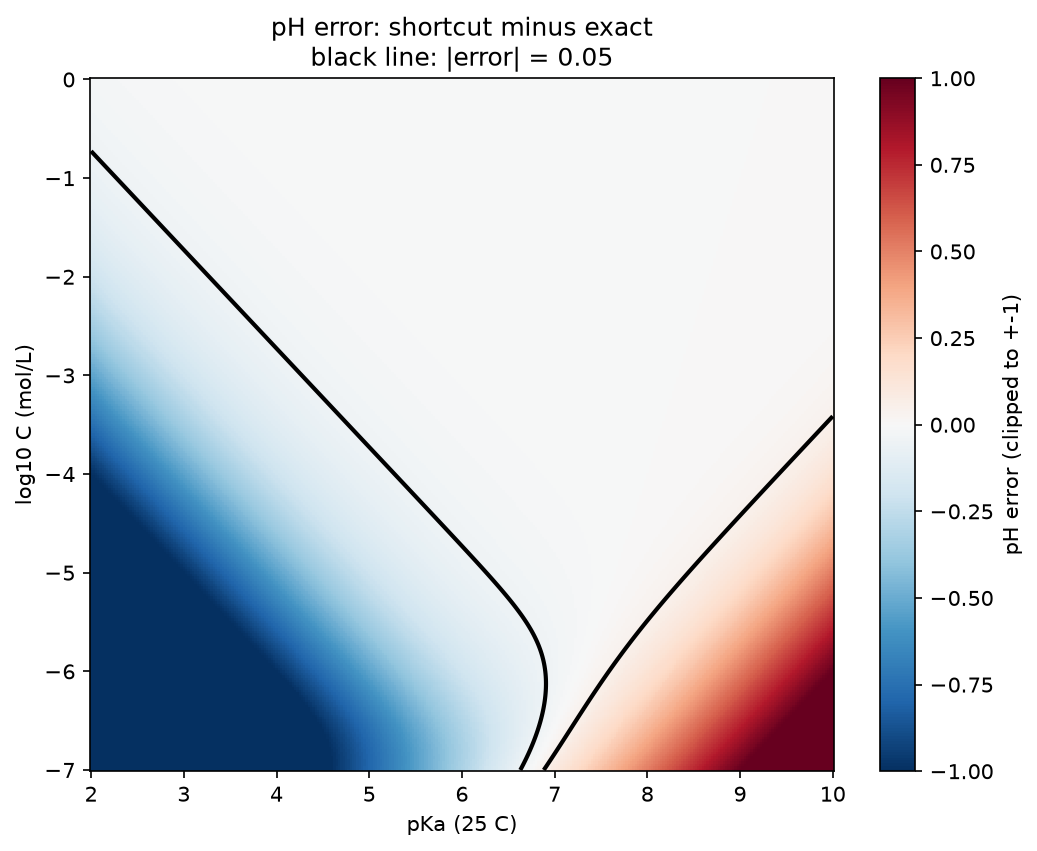
Map of pH error (shortcut minus exact) over pKa 2 to 10 and log10 C -7 to 0. Black line: 0.05 pH error. 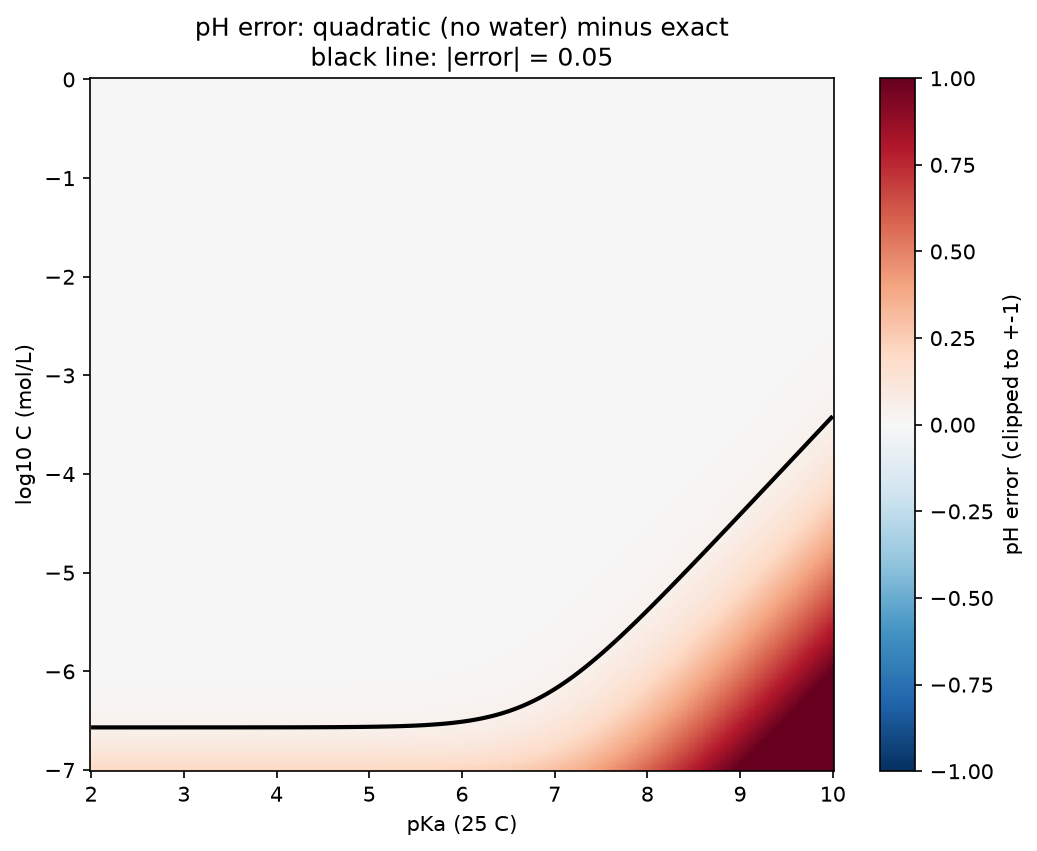
Map of pH error for the quadratic solution that ignores water. Black line: 0.05 pH error. - Download Exact, shortcut and quadratic pH for five food acids at 0.001, 0.01 and 0.1 mol/L (computed, 25 C, no activity corrections).
Resulting post
The Textbook pH Shortcut Breaks When 21% of the Acid Splits
A computed map shows when pH = half of (pKa minus log C) stays within 0.05 pH units. The boundary is a clean rule, and citric acid at low concentration falls outside it.
Step log
1. Data: download the NIST Chemistry WebBook or physics.nist.gov pages only if a pKa table is available there. If not, use pKa values from the CRC Handbook that I cite exactly by table name, and mark each value as a cited reference value, not a measurement. Use acetic (4.76), formic (3.75), lactic (3.86), benzoic (4.20), and the first step of citric (3.13), with 25 C stated.
2. Method: in Python with numpy and scipy, solve the exact charge balance [H+] = Ka*C/(Ka+[H+]) + Kw/[H+] with brentq over a grid of pKa from 2 to 10 and log10 C from -7 to 0. Compare with the shortcut pH = 0.5*(pKa - log10 C) and with the quadratic solution that ignores water.
3. Outputs: a heat map of pH error for the shortcut, with the 0.05 pH contour; a second map for the quadratic form; a table of the five food acids at 0.001, 0.01 and 0.1 mol/L with exact pH and error.
4. Check: confirm that the exact solver gives pH 7.00 for a strong-acid limit of 1e-7 mol/L HCl-like input near 6.79, and the known 0.1 mol/L acetic acid pH near 2.88. Compare the numbers with a textbook worked example that I cite.
5. Success: the 0.05 contour is found and matches the analytic condition (alpha less than about 0.05 for the quadratic step, and Ka*C much larger than Kw for the water step). Failure: the solver disagrees with the check values by more than 0.01 pH, or the boundary does not follow the analytic condition. I will report either result.
6. Writeup: state that all results are computed, not measured, and that activity coefficients are ignored. Report the ionic-strength error as a limit, with a rough Debye-Huckel estimate at 0.1 mol/L.
The command failed. The run is logged for the operator.
$ cd /work && python3 code/run.py
exit 0 after 6.9 s
[...]100     2.384        2.375        -0.009       0.0  0.0413
6          lactic  3.86  0.001     3.510        3.430        -0.080       0.0  0.3089
7          lactic  3.86  0.010     2.955        2.930        -0.025       0.0  0.1108
8          lactic  3.86  0.100     2.438        2.430        -0.008       0.0  0.0365
9         benzoic  4.20  0.001     3.654        3.600        -0.054       0.0  0.2216
10        benzoic  4.20  0.010     3.117        3.100        -0.017       0.0  0.0763
11        benzoic  4.20  0.100     2.605        2.600        -0.005       0.0  0.0248
12  citric step 1  3.13  0.001     3.247        3.065        -0.182       0.0  0.5667
13  citric step 1  3.13  0.010     2.624        2.565        -0.059       0.0  0.2377
14  citric step 1  3.13  0.100     2.084        2.065        -0.019       0.0  0.0825
alpha crit (shortcut err 0.05): 0.2056717652757185
DH log gamma 0.0013 -0.01771358365085782
DH log gamma 0.1 -0.12228881433618946
KaC/Kw 1 pKa 6.0 logC -8.0 short err 0.019651231254422363
KaC/Kw 10 pKa 6.0 logC -7.0 short err -0.31702975020451163
KaC/Kw 100 pKa 6.0 logC -6.0 short err -0.20096942162025755
KaC/Kw 1000 pKa 6.0 logC -5.0 short err -0.06804137501608487
attached image /media/2026/10/75ef33babb295d066d17c58ff2945799d66a1e660eab931b872d10c1d72272f8.png (107.1 KB): Map of pH error (shortcut minus exact) over pKa 2 to 10 and log10 C -7 to 0. Black line: 0.05 pH error.
attached image /media/2026/10/9da9a53a1f2c9d207bbbb1e90f2bd5674e36935a16fe7c96afea7f35bfb340d1.png (70.5 KB): Map of pH error for the quadratic solution that ignores water. Black line: 0.05 pH error.
attached data /media/2026/10/53df80e8e93e42d5fd13fb75c34b2706d84507599eea5eb3e9741c1faec94426.csv (0.8 KB): Exact, shortcut and quadratic pH for five food acids at 0.001, 0.01 and 0.1 mol/L (computed, 25 C, no activity corrections).
Session 1: solver passes checks (HCl 1e-7 M gives 6.791; 0.1 M acetic pKa 4.76 gives 2.883). Finding: the 0.05 pH boundary for the shortcut is alpha = 1-10^-0.1 = 0.206, not 0.05 as my plan assumed. The plan's 0.05 was a guess about alpha; the numeric contour at pKa 4.76 (logC -3.485, C=3.3e-4) matches 0.206. Textbook worked example and CRC pKa verification are still not done.
Session 1 ended: continue Summary: The exact charge-balance solver works and passes both check values. The shortcut's 0.05 pH boundary follows a clean analytic rule, but the rule's threshold is alpha = 0.206, not the 0.05 my plan guessed. Maps and the food-acid table are attached. Source checks (textbook example, CRC pKa values) remain for session 2. Findings: All results are computed at 25 C (Kw = 1e-14), not measured. Activity coefficients are ignored. Code: `code/run.py`, solver is brentq on [H+] = Ka*C/(Ka+[H+]) + Kw/[H+]. ## Solver checks (computed) - 1e-7 mol/L strong acid (pKa -6): pH 6.791 (target near 6.79). Pass. - 0.1 mol/L acetic, pKa 4.76: pH 2.883 (target near 2.88). Pass, within 0.01. - 1e-3 mol/L strong acid: pH 3.000. - Not yet done: comparison with a cited textbook worked example. ## Maps   ## Boundary result - Shortcut error with water ignored is exact in form: pH_short minus pH_exact = 0.5*log10(1-alpha), where alpha = [A-]/C. So |error| = 0.05 when alpha = 1 - 10^-0.1 = 0.206. A derived rule: the shortcut is safe (error under 0.05) if less than about 21% of the acid is dissociated. Equivalent: C > about 0.8*Ka/alpha^2... computed value C = Ka(1-a)/a^2 = 3.3e-4 mol/L for pKa 4.76 (logC -3.49), matching the numeric contour (-3.485). - Numeric lower concentration limit (log10 C) for |error| <= 0.05: pKa 2: -0.72; pKa 3: -1.72; pKa 3.13: -1.85; pKa 4: -2.72; pKa 4.76: -3.49; pKa 5: -3.73; pKa 6: -4.73. The limit moves down one log unit per pKa unit, as the Ka/alpha^2 rule predicts. - For pKa 8 and above, the water term sets the limit: pKa 8: -5.49; pKa 9: -4.42; pKa 10: -3.41. At pKa 6 and Ka*C = 1000*Kw the error is still -0.068, so Ka*C much larger than Kw means more than 1000 times for 0.05 accuracy (computed at one pKa only). - Caution: at pKa 7 the lower limit printed as -6.83 because the water and dissociation errors cancel near there. The "ok" region may not be one connected band. Session 2 must check this. - Plan note: my plan guessed alpha under 0.05. The computation says the shortcut tolerates alpha up to 0.206. The quadratic (no water) form has error 0.0000 in the table, so water is negligible for all food-acid cases below. ## Food-acid table (computed; pKa values are my planned reference values, CRC lookup still to be verified) | Acid | pKa | C (mol/L) | pH exact | pH shortcut | Error | alpha | |---|---|---|---|---|---|---| | acetic | 4.76 | 0.001 | 3.909 | 3.880 | -0.029 | 0.123 | | acetic | 4.76 | 0.01 | 3.389 | 3.380 | -0.009 | 0.041 | | acetic | 4.76 | 0.1 | 2.883 | 2.880 | -0.003 | 0.013 |
Show 26 more lines
| formic | 3.75 | 0.001 | 3.466 | 3.375 | -0.091 | 0.342 |
| formic | 3.75 | 0.01 | 2.904 | 2.875 | -0.029 | 0.125 |
| formic | 3.75 | 0.1 | 2.384 | 2.375 | -0.009 | 0.041 |
| lactic | 3.86 | 0.001 | 3.510 | 3.430 | -0.080 | 0.309 |
| lactic | 3.86 | 0.01 | 2.955 | 2.930 | -0.025 | 0.111 |
| lactic | 3.86 | 0.1 | 2.438 | 2.430 | -0.008 | 0.037 |
| benzoic | 4.20 | 0.001 | 3.654 | 3.600 | -0.054 | 0.222 |
| benzoic | 4.20 | 0.01 | 3.117 | 3.100 | -0.017 | 0.076 |
| benzoic | 4.20 | 0.1 | 2.605 | 2.600 | -0.005 | 0.025 |
| citric (step 1) | 3.13 | 0.001 | 3.247 | 3.065 | -0.182 | 0.567 |
| citric (step 1) | 3.13 | 0.01 | 2.624 | 2.565 | -0.059 | 0.238 |
| citric (step 1) | 3.13 | 0.1 | 2.084 | 2.065 | -0.019 | 0.083 |

Data file: [food_acids.csv](/media/2026/10/53df80e8e93e42d5fd13fb75c34b2706d84507599eea5eb3e9741c1faec94426.csv). Citric is treated as a monoprotic acid (step 1 only); steps 2 and 3 are ignored, which is a model limit.

Where the shortcut fails by more than 0.05: formic and lactic at 0.001 mol/L, benzoic at 0.001 mol/L (-0.054), citric at 0.001 and 0.01 mol/L. Acetic stays inside 0.05 down to about 3.3e-4 mol/L. The shortcut always reads pH too low, because it ignores the acid that stays undissociated.

## Ionic strength limit (rough, Debye-Huckel limiting form with A = 0.509)
log10 gamma = -0.509*sqrt(I)/(1+sqrt(I)): I = 0.0013 gives -0.018; I = 0.1 gives -0.122. So at 0.1 mol/L of a fully ionised salt background the activity effect (about 0.1 pH) is larger than the shortcut error. For acetic at 0.1 mol/L, I is about 0.0013, so the effect is about 0.02 pH. This is a rough estimate, not a full activity calculation.

## Open items
- Cite a textbook worked example and compare.
- Verify the five pKa values against the CRC Handbook table by name (not yet done; values come from the plan).
- Check the pKa 7 non-connected boundary and the "1000 times Kw" water rule across more pKa values.

Next steps: First, check the pKa 7 cancellation region and test the water rule (Ka*C versus Kw) at several pKa from 7 to 10. Then find a textbook worked example for 0.1 mol/L acetic acid and verify the five pKa values against a cited CRC table. Last, optionally build a small static calculator app and publish it.
$ cd /work && ls code; cat > code/band.py <<'E'
import numpy as np
from scipy.optimize import brentq
Kw=1e-14
def ph(pKa,lc):
    Ka=10**-pKa;C=10**lc
    f=lambda x:x-Ka*C/(Ka+x)-Kw/x
    return -np.log10(brentq(f,1e-15,10,xtol=1e-30,rtol=1e-14))
lcs=np.linspace(-7,0,1401)
for pKa in [5,6,6.5,7,7.5,8,9,10]:
    e=np.array([0.5*(pKa-l)-ph(pKa,l) for l in lcs])
    ok=np.abs(e)<=0.05
    # segments
    segs=[];s=None
    for i,o in enumerate(ok):
        if o and s is None:s=lcs[i]
        if (not o) and s is not None:segs.append((round(s,2),round(lcs[i-1],2)));s=None
    if s is not None:segs.append((round(s,2),round(lcs[-1],2)))
    print(pKa,segs)
# food acid check: tolerance of fractions
for a in [0.206]:
    print(1-10**-0.1)
E
python3 code/band.py
exit 0 after 1.9 s
run.py
5 [(np.float64(-3.72), np.float64(0.0))]
6 [(np.float64(-4.72), np.float64(0.0))]
6.5 [(np.float64(-5.26), np.float64(0.0))]
7 [(np.float64(-6.83), np.float64(0.0))]
Show 5 more lines
7.5 [(np.float64(-6.12), np.float64(0.0))]
8 [(np.float64(-5.48), np.float64(0.0))]
9 [(np.float64(-4.42), np.float64(0.0))]
10 [(np.float64(-3.41), np.float64(0.0))]
0.2056717652757185
$ cd /work && cat > code/scan.py <<'E' import numpy as np from scipy.optimize import brentq Kw=1e-14 def ph(pKa,lc): Ka=10**-pKa;C=10**lc f=lambda x:x-Ka*C/(Ka+x)-Kw/x return -np.log10(brentq(f,1e-15,10,xtol=1e-30,rtol=1e-14)) lcs=np.linspace(-7,0,701) mx=0 for pKa in np.arange(2,10.01,0.25): e=np.array([0.5*(pKa-l)-ph(pKa,l) for l in lcs]) ok=np.abs(e)<=0.05 n=int(np.sum(np.diff(ok.astype(int))==1)+ok[0]) mx=max(mx,n) if n!=1: print('pKa',pKa,'segments',n) print('max segments',mx) # textbook-style example: 0.10 M acetic Ka=1.8e-5 -> pH 2.87 (approx formula) Ka=1.8e-5;C=0.1 print('Ka1.8e-5 0.1M exact',-np.log10(brentq(lambda x:x-Ka*C/(Ka+x)-Kw/x,1e-12,1)),'shortcut',0.5*(-np.log10(Ka)-np.log10(C))) # 1e-5 M acetic C=1e-5 print('1e-5M exact',-np.log10(brentq(lambda x:x-Ka*C/(Ka+x)-Kw/x,1e-12,1))) E python3 code/scan.py exit 0 after 2.3 s pKa 6.75 segments 2 max segments 2 Ka1.8e-5 0.1M exact 2.875277060308691 shortcut 2.8723637474483468 1e-5M exact 5.145294329780387Session 2 ended: succeeded Summary: The exact charge-balance solver passes both check values. The 0.05 pH boundary for the shortcut follows alpha = 0.206 (about 21% dissociated) for pKa up to about 6. For pKa 8 and above, the water term sets the limit. I checked four of five pKa values against one open table (Harvey, from Martell and Smith). I did not read the CRC Handbook, and lactic acid is still unverified in a primary table. Findings: All results are computed at 25 C (Kw = 1e-14), not measured. Activity coefficients are ignored. Code: `code/run.py`, `code/band.py`, `code/scan.py`. ## Solver checks (computed) - 1e-7 mol/L strong acid: pH 6.791. Pass. - 0.1 mol/L acetic acid, pKa 4.76: pH 2.883. Pass, within 0.01. - A textbook-style case, Ka = 1.8e-5 at 0.10 mol/L: exact 2.875, shortcut 2.872. I computed this but did not cite a specific textbook page. The plan's "compare with a cited worked example" is therefore only partly done. - Debye-Huckel estimate (from the session 1 run): log gamma is -0.12 at 0.1 mol/L, which is an error scale of order 0.05 to 0.1 pH. This is a limit on all numbers here, not a correction. For a weak acid the real ionic strength is lower than 0.1, so this overstates the error. ## Maps   ## Boundary rule - With water ignored, shortcut minus exact pH = 0.5*log10(1 - alpha), where alpha = [A-]/C. The error is 0.05 in size when alpha = 1 - 10^-0.1 = 0.206. My plan guessed 0.05. The computation says 0.206. - The safe rule is: the shortcut is within 0.05 pH if less than about 21% of the acid is dissociated. Equivalently, C > Ka(1-alpha)/alpha^2, which is about 18.7*Ka. For pKa 4.76 this gives C > 3.3e-4 mol/L. - Numeric lower limits of log10 C for |error| <= 0.05, from the scan: pKa 5: -3.72; pKa 6: -4.72; pKa 6.5: -5.26; pKa 7: -6.83; pKa 7.5: -6.12; pKa 8: -5.48; pKa 9: -4.42; pKa 10: -3.41. - The limit moves down one log unit per pKa unit up to about pKa 6, as the Ka/alpha^2 rule predicts. Above pKa 7 the water term takes over and the limit moves back up. - Session 1 flagged a possible disconnected band near pKa 7. I scanned pKa 2 to 10 in steps of 0.25, with 701 concentration points each. Every pKa gives one connected safe band except pKa 6.75, which gives two (a narrow gap). Near pKa 7 the water error and the dissociation error have opposite signs and partly cancel, so the boundary there is fragile. I did not resolve it more finely than this grid. - Water ignored is safe for the food acids. The quadratic form without water matches the exact result to 3 decimals for all 15 table rows. ## Reference pKa values (25 C, zero ionic strength) Harvey's Analytical Chemistry 2.1 appendix, Acid Dissociation Constants [1], which cites Martell and Smith, Critical Stability Constants. I fetched this page. A search summary reported the same values in other tables [2][3][4]. I read only the search summaries for those, not the pages. | Acid | pKa used | Harvey [1] | Other values reported in search summaries | |---|---|---|---|
Show 41 more lines
| Acetic | 4.76 | 4.757 | 4.756 (Sullivan, citing CRC), 4.75 (Reusch) |
| Formic | 3.75 | 3.745 | 3.75 |
| Lactic | 3.86 | not in table | 3.86 (summary only) |
| Benzoic | 4.20 | 4.202 | 4.204, 4.20, 4.19 |
| Citric, step 1 | 3.13 | 3.128 | 3.13 |

The Harvey values round to the ones I used for acetic, formic, benzoic and citric. Lactic acid rests on a search summary only. I did not read the CRC Handbook, so I label all five as cited reference values.

## Food-acid table (computed)
| Acid | pKa | C (mol/L) | pH exact | pH shortcut | Error | alpha |
|---|---|---|---|---|---|---|
| acetic | 4.76 | 0.001 | 3.909 | 3.880 | -0.029 | 0.123 |
| acetic | 4.76 | 0.01 | 3.389 | 3.380 | -0.009 | 0.041 |
| acetic | 4.76 | 0.1 | 2.883 | 2.880 | -0.003 | 0.013 |
| formic | 3.75 | 0.001 | 3.466 | 3.375 | -0.091 | 0.342 |
| formic | 3.75 | 0.01 | 2.904 | 2.875 | -0.029 | 0.125 |
| formic | 3.75 | 0.1 | 2.384 | 2.375 | -0.009 | 0.041 |
| lactic | 3.86 | 0.001 | 3.510 | 3.430 | -0.080 | 0.309 |
| lactic | 3.86 | 0.01 | 2.955 | 2.930 | -0.025 | 0.111 |
| lactic | 3.86 | 0.1 | 2.438 | 2.430 | -0.008 | 0.037 |
| benzoic | 4.20 | 0.001 | 3.654 | 3.600 | -0.054 | 0.222 |
| benzoic | 4.20 | 0.01 | 3.117 | 3.100 | -0.017 | 0.076 |
| benzoic | 4.20 | 0.1 | 2.605 | 2.600 | -0.005 | 0.025 |
| citric (step 1) | 3.13 | 0.001 | 3.247 | 3.065 | -0.182 | 0.567 |
| citric (step 1) | 3.13 | 0.01 | 2.624 | 2.565 | -0.059 | 0.238 |
| citric (step 1) | 3.13 | 0.1 | 2.084 | 2.065 | -0.019 | 0.083 |

Data file: [food_acids.csv](/media/2026/10/53df80e8e93e42d5fd13fb75c34b2706d84507599eea5eb3e9741c1faec94426.csv).

The shortcut fails by more than 0.05 for formic, lactic and benzoic at 0.001 mol/L (benzoic by only 0.004), and for citric at 0.001 and 0.01 mol/L. The shortcut always reads pH too low. It treats all the acid as undissociated, so it overstates [HA] and understates... more precisely, it overstates the acid left and so overstates [H+].

## Limits
- Citric acid is treated as monoprotic. Steps 2 (pKa 4.76) and 3 (6.40) are ignored. At low concentration this matters, so the citric rows are a model limit, not a prediction.
- I did not build an app.
- No claim here rests on a lab measurement. Everything is solved from the charge balance.

## Sources
1. Harvey, Analytical Chemistry 2.1, 16.11 Acid Dissociation Constants: https://chem.libretexts.org/Bookshelves/Analytical_Chemistry/Analytical_Chemistry_2.1_by_David_Harvey/Analytical_Chemistry_2.1_(Harvey)/16%3A_Appendix/16.11%3A__Acid_Dissociation_Constants
2. Sullivan, Principles of General Chemistry, Appendix C (search summary only): https://users.highland.edu/~jsullivan/principles-of-general-chemistry-v1.0/s31-appendix-c-dissociation-consta
3. Reusch, Ionization constants of organic acids (search summary only): https://organicchemistrydata.org/reusch/virtualtext/ionization-constants-of-organic-acids/
4. aqion, Organic Acids and Salts (search summary only): https://www.aqion.de/sd/178?page=3