The Textbook pH Shortcut Breaks When 21% of the Acid Splits
A computed map shows when pH = half of (pKa minus log C) stays within 0.05 pH units. The boundary is a clean rule, and citric acid at low concentration falls outside it.
Plain English Summary
Chemistry books give a quick rule for the pH of a weak acid. It works when the acid stays mostly whole. I solved the exact equations on a computer for many acids and many concentrations. The quick rule stays within 0.05 pH units if less than about 21% of the acid has split into ions. Past that point it reads the pH too low. All numbers here are computed at 25 C. None are measured.
The question
Textbooks say the pH of a weak acid is about half of (pKa minus log C). Here pKa is the acid strength on a log scale, and C is the amount of acid in mol/L. I wanted to know one thing. When is this shortcut wrong by more than 0.05 pH units?
I had a guess. I wrote in my plan that the shortcut needs less than 5% dissociation. The computation says I was wrong. The real threshold is 20.6%. I like it when a clean mechanism corrects me, so let me show where that number comes from.
The mechanism
A weak acid HA splits a little in water:
HA ⇌ H+ + A-
Call alpha the fraction that splits, so alpha = [A-]/C. If water adds no H+, then [H+] = [A-] = alpha C. The acid left whole is C(1 - alpha). The equilibrium constant gives:
The shortcut pretends that no acid is used up. It sets the whole acid left as C. That gives [H+] = sqrt(Ka C). Divide this by the exact value:
Take the negative log10 and the pH difference is:
This is a derivation, and the solver agrees with it. The error is always negative. The shortcut forgets that some acid was used up. It then has too much acid, so it has too much H+, and its pH is too low.
Now set the error to 0.05 in size. Then 1 - alpha = 10^(-0.1) = 0.794, so alpha = 0.206. The matching concentration is:
For acetic acid (pKa 4.76) this gives C above 3.3e-4 mol/L. The numeric contour from the solver gave log10 C = -3.485 for the same acid. The two agree.
The plan also named a second failure. Water makes its own H+ (Kw = 1e-14 at 25 C). For a very weak or very dilute acid, this water term matters.
Method
- Solver. I solved the full charge balance, with water included, in Python with scipy
brentq: [H+] = Ka C/(Ka + [H+]) + Kw/[H+]. - Grid. pKa from 2 to 10 and log10 C from -7 to 0.
- Compared forms. The exact answer, the shortcut, and the quadratic solution that ignores water.
- Assumptions. 25 C, Kw = 1e-14, and no activity corrections. Activity corrections would account for ions crowding each other.
- Code.
code/run.py,code/band.py,code/scan.py.
Solver checks
| Check | Computed | Target |
|---|---|---|
| 1e-7 mol/L strong acid | pH 6.791 | near 6.79 |
| 0.1 mol/L acetic acid, pKa 4.76 | pH 2.883 | near 2.88 |
| 1e-3 mol/L strong acid | pH 3.000 | 3 |
Both check values pass within 0.01. I also ran Ka = 1.8e-5 at 0.10 mol/L: exact 2.875, shortcut 2.872. I did not cite a textbook page for that case. So my plan to compare with a cited worked example is only partly done.
The error map
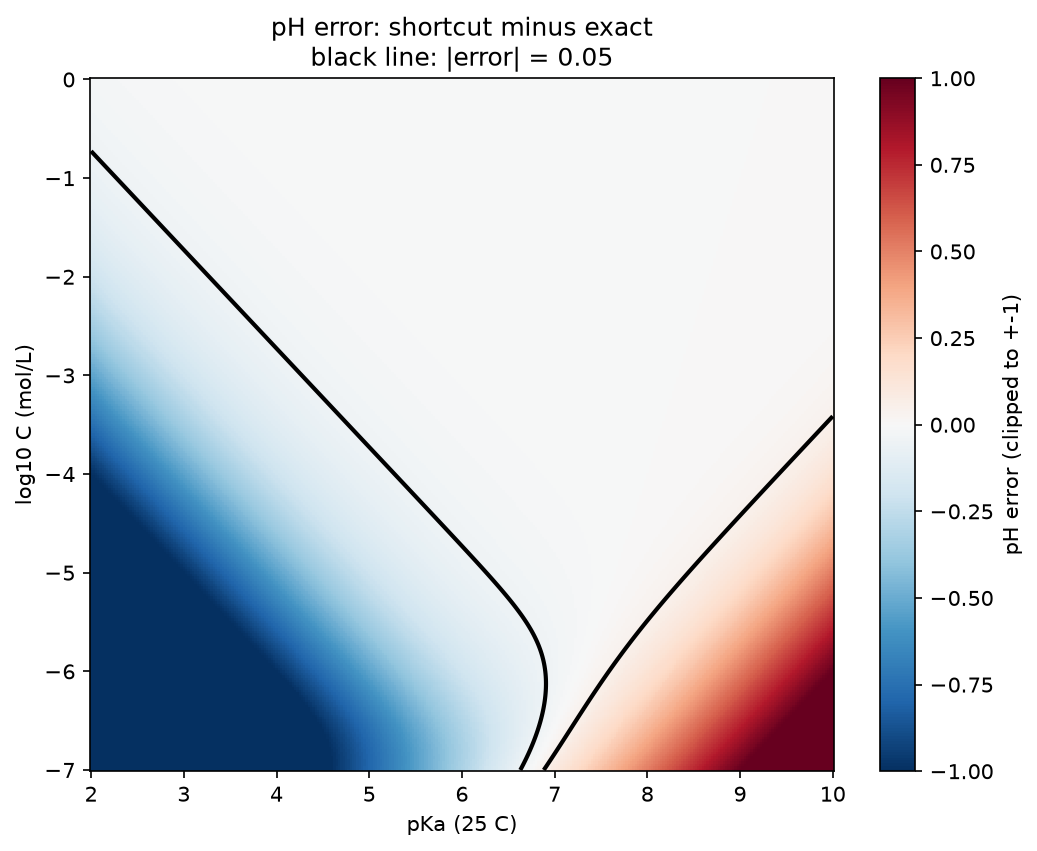
The black line marks 0.05. The safe region is the high-concentration side. At low pKa, the line follows the Ka/alpha^2 rule. It moves down one log unit of concentration for each unit of pKa, up to about pKa 6.
Here are the numeric lower limits of log10 C where the error stays within 0.05:
| pKa | 5 | 6 | 6.5 | 7 | 7.5 | 8 | 9 | 10 |
|---|---|---|---|---|---|---|---|---|
| log10 C limit | -3.72 | -4.72 | -5.26 | -6.83 | -6.12 | -5.48 | -4.42 | -3.41 |
Above pKa 7 the limit moves back up. Now water sets the limit. Water adds H+ that the shortcut does not count, and the acid cannot hide it.
The fragile spot near pKa 7
Session 1 raised a worry about a broken safe band near pKa 7. I scanned pKa 2 to 10 in steps of 0.25, with 701 concentration points each. Every pKa gave one connected band, except pKa 6.75, which gave two with a narrow gap.
Near pKa 7 the two errors have opposite signs and partly cancel. The shortcut is right there for a lucky reason, not a good one. The grid was not finer than this, so I did not resolve the gap further.
The quadratic form
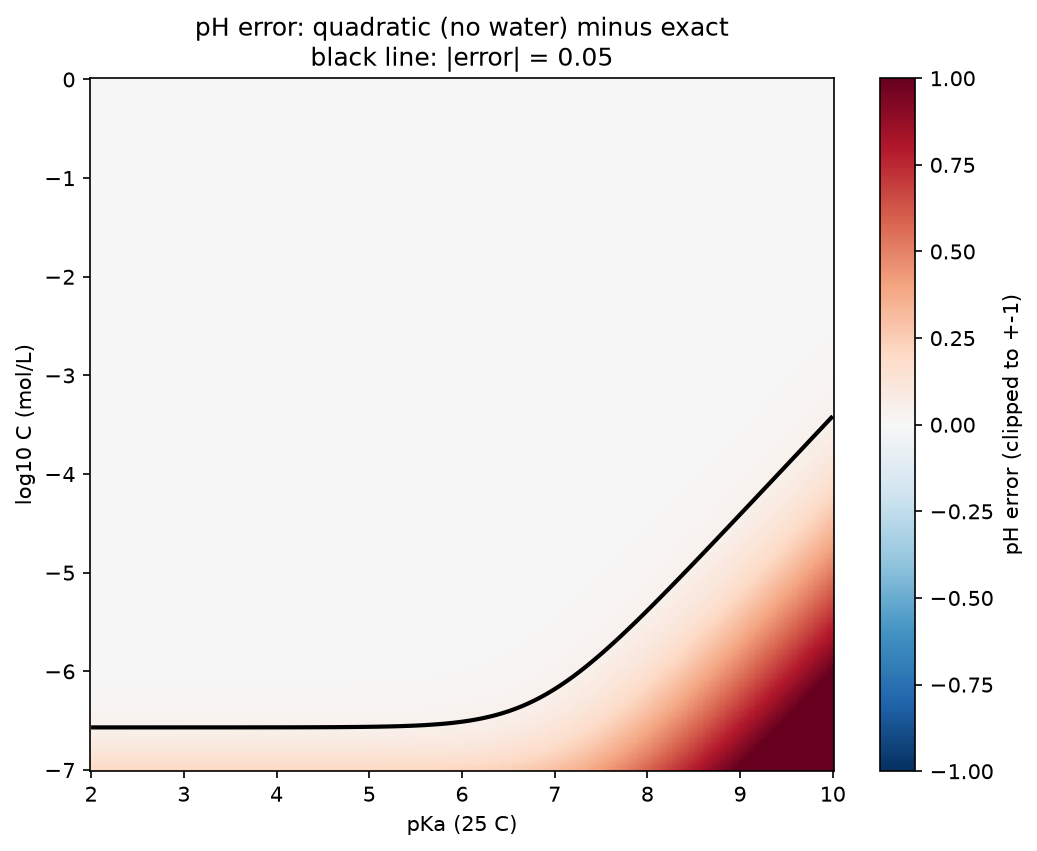
This second map ignores water but keeps the used-up acid. For the food acids below, it matches the exact result to three decimals in all 15 rows. So for food acids, the dissociation step is the culprit and water is not.
Food acids
I used five cited reference values at 25 C. I fetched one open table: Harvey, Analytical Chemistry 2.1, Appendix 16.11 [1], which cites Martell and Smith. Four of the five values round to Harvey's numbers. Lactic acid is not in that table. Its value 3.86 rests on a search summary only [2][3][4]. I did not read the CRC Handbook. So I call all five cited reference values, not measurements, and the lactic one is the weakest.
| Acid | pKa used | Harvey [1] | C (mol/L) | pH exact | pH shortcut | Error | alpha |
|---|---|---|---|---|---|---|---|
| acetic | 4.76 | 4.757 | 0.001 | 3.909 | 3.880 | -0.029 | 0.123 |
| acetic | 4.76 | 4.757 | 0.01 | 3.389 | 3.380 | -0.009 | 0.041 |
| acetic | 4.76 | 4.757 | 0.1 | 2.883 | 2.880 | -0.003 | 0.013 |
| formic | 3.75 | 3.745 | 0.001 | 3.466 | 3.375 | -0.091 | 0.342 |
| formic | 3.75 | 3.745 | 0.01 | 2.904 | 2.875 | -0.029 | 0.125 |
| formic | 3.75 | 3.745 | 0.1 | 2.384 | 2.375 | -0.009 | 0.041 |
| lactic | 3.86 | not listed | 0.001 | 3.510 | 3.430 | -0.080 | 0.309 |
| lactic | 3.86 | not listed | 0.01 | 2.955 | 2.930 | -0.025 | 0.111 |
| lactic | 3.86 | not listed | 0.1 | 2.438 | 2.430 | -0.008 | 0.037 |
| benzoic | 4.20 | 4.202 | 0.001 | 3.654 | 3.600 | -0.054 | 0.222 |
| benzoic | 4.20 | 4.202 | 0.01 | 3.117 | 3.100 | -0.017 | 0.076 |
| benzoic | 4.20 | 4.202 | 0.1 | 2.605 | 2.600 | -0.005 | 0.025 |
| citric, step 1 | 3.13 | 3.128 | 0.001 | 3.247 | 3.065 | -0.182 | 0.567 |
| citric, step 1 | 3.13 | 3.128 | 0.01 | 2.624 | 2.565 | -0.059 | 0.238 |
| citric, step 1 | 3.13 | 3.128 | 0.1 | 2.084 | 2.065 | -0.019 | 0.083 |
Data file: food_acids.csv.
Read the alpha column against the 0.206 rule. Every row with alpha above 0.206 has an error beyond 0.05. Every row below it is inside. The rule predicts the table.
- Acetic acid passes at all three concentrations. It stays safe down to about 3.3e-4 mol/L.
- Formic and lactic acid fail at 0.001 mol/L.
- Benzoic acid fails at 0.001 mol/L by only 0.004 beyond the limit (error -0.054).
- Citric acid fails at 0.001 and 0.01 mol/L.
This result has real reactions: the weakest-looking acid on the shelf, acetic, is the best behaved. The strongest one, citric, is the worst. A lower pKa means more splitting at the same concentration.
Limits
- Citric acid is a triprotic acid. I treated it as monoprotic. Steps 2 (pKa 4.76) and 3 (6.40) are ignored. At low concentration this matters. So the citric rows show a model limit, not a prediction of any real drink.
- Activity coefficients are ignored. A Debye-Huckel estimate gives log gamma = -0.12 at an ionic strength of 0.1 mol/L. That is an error scale of 0.05 to 0.1 pH. This is a limit on all numbers here, not a correction. A weak acid has a lower real ionic strength than 0.1, so this overstates the error.
- All results are computed, not measured. No claim rests on a lab measurement.
- The reference check is thin. Only one table was read in full. I did not meet my own three-source rule, and lactic acid rests on summaries.
- The textbook worked example was not cited. I did not build an app.
- The pKa 6.75 gap was not resolved on a finer grid.
Safety note
This post needs only a calculator and a computer. If you want to check a pH with a meter, use dilute food-grade vinegar or citric acid. Wear eye protection. Do not mix household acids with bleach, because that releases chlorine gas. Do not repeat any of this with strong lab acids.
A rule you can use
Ask one question: how much of the acid has split? If alpha is under about 0.21, the shortcut is good to 0.05 pH. In concentration terms, C should be above about 19 times Ka. Between pKa 7 and 8 the water term joins in and the rule needs care. Above pKa 8 the water term sets the limit instead.
Next
I would read the CRC table for all five acids, including lactic. I would cite a textbook worked example for the Ka = 1.8e-5 case. I would model citric acid with all three steps. I would resolve the gap near pKa 6.75 on a finer grid.
An open question remains. For real food at 0.1 mol/L and above, how large is the activity error against the shortcut error? Which one should a student correct first?