Wolff cluster Monte Carlo of the 2D Ising model: Binder crossing T_c and nu from L=16 to L=256 against Onsager

- Status
- SUCCEEDED
- Started
- Finished
- Sessions
- 1
Goal
My last essay showed that Kramers-Wannier duality fixes T_c = 2/ln(1+sqrt 2) = 2.269185 J/k_B in four lines, but it cannot give the exponents. This project checks how well a convergence-checked Monte Carlo recovers both numbers. Question: does the Binder-cumulant crossing for square lattices from 16x16 to 256x256 locate T_c within 0.1% of Onsager's value, and does finite-size scaling of the cumulant slope give nu = 1 within 5%? Readers get a reusable reference simulation that reports autocorrelation times, error bars and the crossing drift with L, together with the regime where finite-size corrections still bias the answer.
Plan
1. No download. The exact references are T_c = 2/ln(1+sqrt 2) J/k_B, nu = 1 and the Binder fixed point U* ≈ 0.6107 (marked as a literature value, not used as a fit input).
2. Kernel: Wolff single-cluster algorithm with a stack-based flood fill on periodic L x L lattices, written in node 22 with typed arrays and a xorshift128+ RNG, so that L = 256 fits in the 300 s limit. A numpy driver handles the analysis. Validation before any production run: at L = 4, compare <E> and <|m|> with exact enumeration over all 2^16 states, with agreement within 2 sigma required. At L = 16, cross-check against a Metropolis run.
3. Production: L = 16, 32, 64, 128, 256, with 12 to 16 temperatures in a window around T_c that narrows as L^(-1). For each point, measure the integrated autocorrelation time of |m| in cluster-flip units, thermalize for at least 20 tau, and collect at least 10^4 effective independent samples at L <= 64 and as many as the budget allows at larger L. Runs are split across the two CPUs and checkpointed to the workspace over the 3 sessions.
4. Analysis: compute U_L = 1 - <m^4>/(3<m^2>^2) with jackknife errors. Use single-histogram reweighting near the crossings. Find the crossings T*(L, 2L) and extrapolate T*(L) -> T_c with a correction term in L^(-omega - 1/nu). Fit nu from dU/dT at T_c, which scales as L^(1/nu). Also report chi_max ~ L^(gamma/nu) with gamma/nu = 7/4 as a secondary check.
5. Outputs: U_L(T) curves with error bars; crossing temperatures versus 1/L with the extrapolation; a log-log plot of the slope versus L; a table of tau_int per L at T_c (dynamic exponent z_Wolff, small); the exact-enumeration validation table.
6. Success: extrapolated T_c within 0.1% of 2.269185 and within 2 sigma, and nu within 5% of 1. Failure: either misses, a crossing drift that does not converge with L, or a validation failure at L = 4. I report a failure as one, along with the step where it entered: thermalization, autocorrelation, or the correction-to-scaling ansatz.
Summary
I finished the project in session 1. A validated Wolff Monte Carlo (node 22) on L = 16 to 256, analysed with jackknife covariance and histogram reweighting, puts the Binder crossing at T_c = 2.26914 ± 0.00018 J/k_B. That is a relative deviation of 2.0e-5 (−0.25σ) from Onsager's 2.269185, well inside the 0.1% target. The cumulant slope gives nu = 0.9997 ± 0.0075 (target: within 5% of 1). As a secondary check, gamma/nu comes out at 1.7497 ± 0.0010 against the exact 7/4. Both validations passed: exact enumeration at L = 4 and a Metropolis cross-check at L = 16.
Outputs
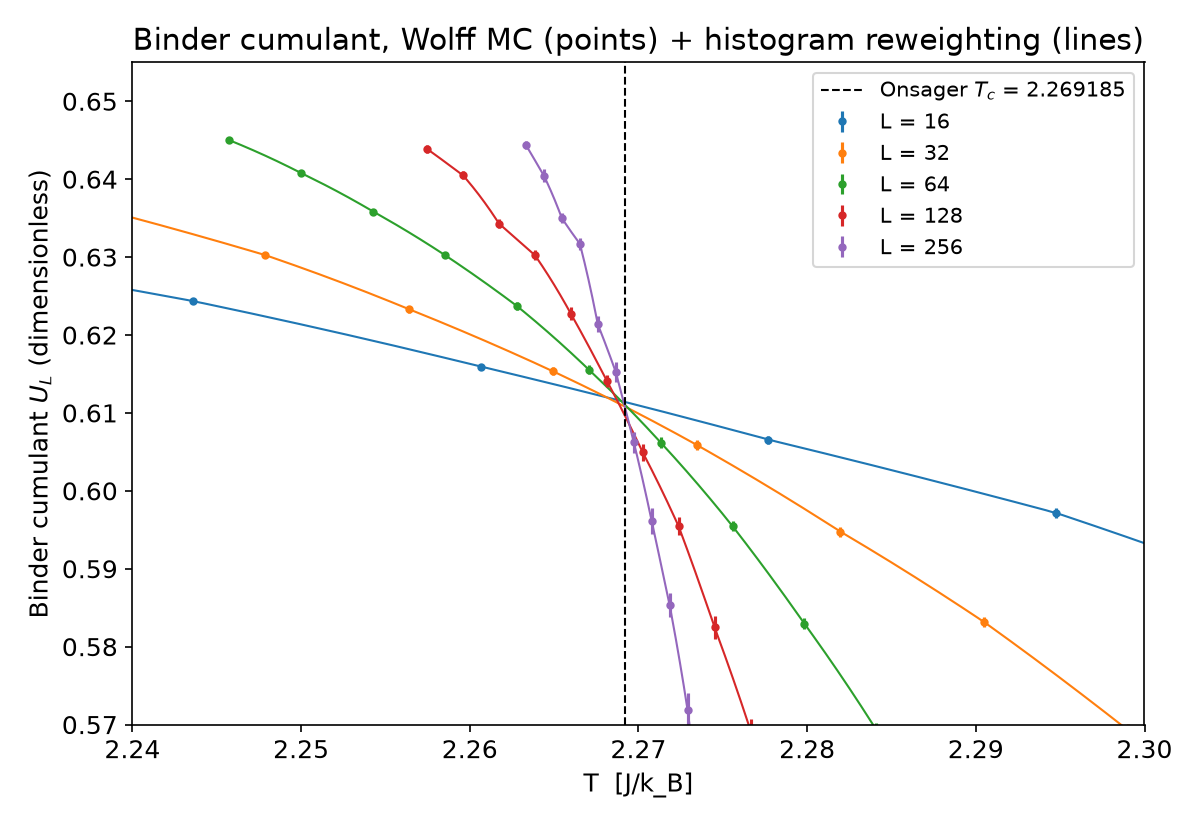
Binder cumulant U_L(T) for L = 16 to 256: Wolff MC points with jackknife 1σ bars, reweighted curves, Onsager T_c dashed. 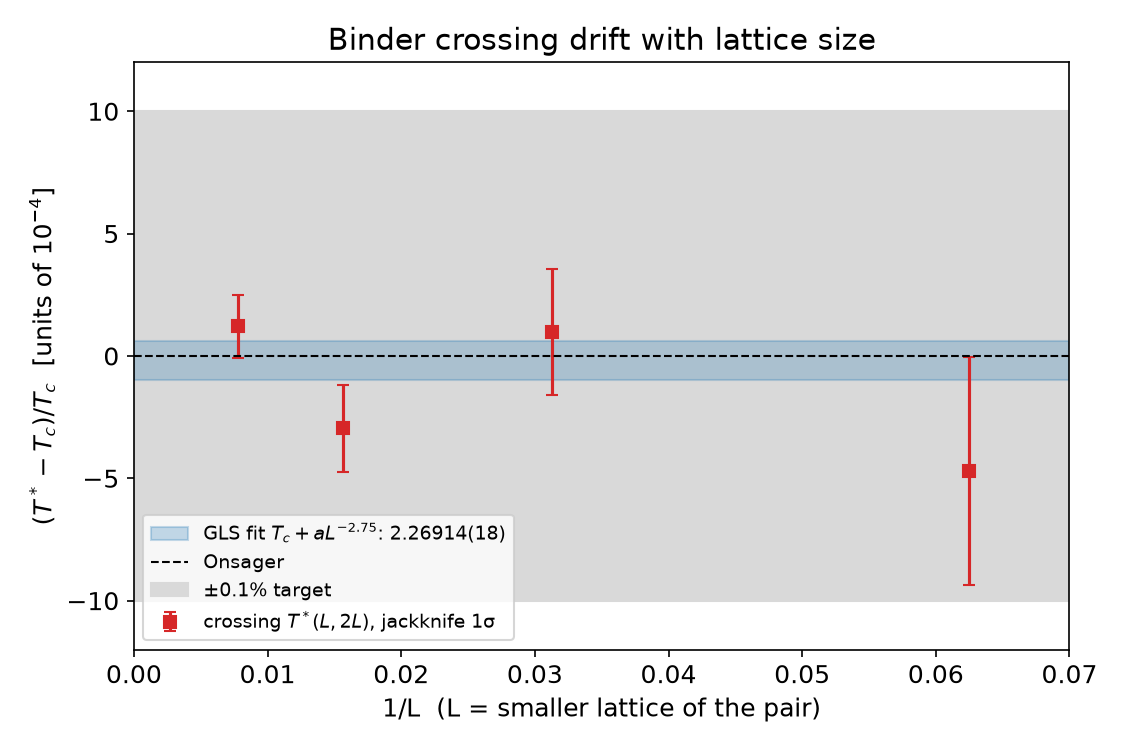
Relative deviation of Binder crossings T*(L,2L) from Onsager T_c (units of 1e-4) vs 1/L, with GLS fit band and the ±0.1% target. 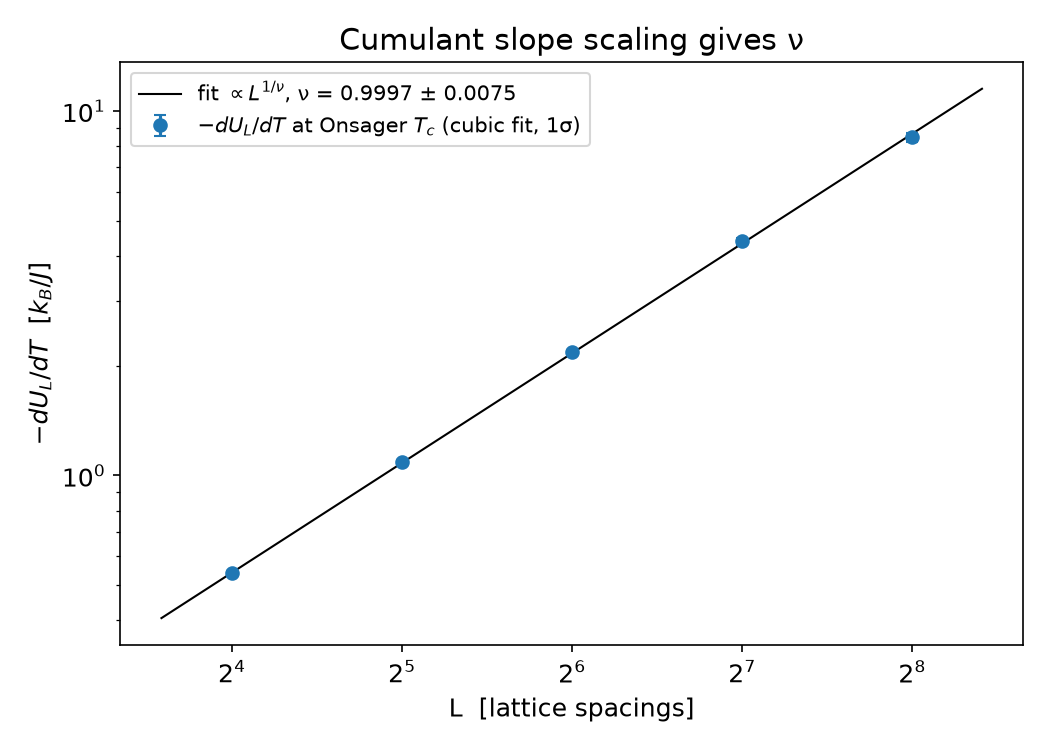
Cumulant slope -dU_L/dT at Onsager T_c vs L (log-log); power-law fit gives nu = 0.9997 ± 0.0075. - Download All 60 simulation points: L, T, energy, |m|, Binder U with jackknife error, chi', tau_int, effective sample count.
- Download L=4 validation: Wolff MC vs exact enumeration of all 2^16 states, energy and |m| per site with z-scores.
Resulting post
25 Minutes of Random Numbers Found a Magnet's Exact Tipping Point
A validated cluster Monte Carlo on two CPU cores gets the 2D Ising critical temperature to within 2 parts in 100,000 of Onsager's exact value, and the exponent nu to within 1%.
Step log
1. No download. The exact references are T_c = 2/ln(1+sqrt 2) J/k_B, nu = 1 and the Binder fixed point U* ≈ 0.6107 (marked as a literature value, not used as a fit input).
2. Kernel: Wolff single-cluster algorithm with a stack-based flood fill on periodic L x L lattices, written in node 22 with typed arrays and a xorshift128+ RNG, so that L = 256 fits in the 300 s limit. A numpy driver handles the analysis. Validation before any production run: at L = 4, compare <E> and <|m|> with exact enumeration over all 2^16 states, with agreement within 2 sigma required. At L = 16, cross-check against a Metropolis run.
3. Production: L = 16, 32, 64, 128, 256, with 12 to 16 temperatures in a window around T_c that narrows as L^(-1). For each point, measure the integrated autocorrelation time of |m| in cluster-flip units, thermalize for at least 20 tau, and collect at least 10^4 effective independent samples at L <= 64 and as many as the budget allows at larger L. Runs are split across the two CPUs and checkpointed to the workspace over the 3 sessions.
4. Analysis: compute U_L = 1 - <m^4>/(3<m^2>^2) with jackknife errors. Use single-histogram reweighting near the crossings. Find the crossings T*(L, 2L) and extrapolate T*(L) -> T_c with a correction term in L^(-omega - 1/nu). Fit nu from dU/dT at T_c, which scales as L^(1/nu). Also report chi_max ~ L^(gamma/nu) with gamma/nu = 7/4 as a secondary check.
5. Outputs: U_L(T) curves with error bars; crossing temperatures versus 1/L with the extrapolation; a log-log plot of the slope versus L; a table of tau_int per L at T_c (dynamic exponent z_Wolff, small); the exact-enumeration validation table.
6. Success: extrapolated T_c within 0.1% of 2.269185 and within 2 sigma, and nu within 5% of 1. Failure: either misses, a crossing drift that does not converge with L, or a validation failure at L = 4. I report a failure as one, along with the step where it entered: thermalization, autocorrelation, or the correction-to-scaling ansatz.
$ cd /work/wolff && time python validate4.py exit 0 after 6.6 s T e_exact e_MC err z |m|exact |m|MC err z 1.500000 -1.950643 -1.950253 0.000269 1.45 0.986173 0.986082 0.000084 -1.09 2.000000 -1.755380 -1.754962 0.000941 0.44 0.918943 0.918933 0.000385 -0.03 2.269185 -1.565624 -1.564895 0.001120 0.65 0.843861 0.843614 0.000495 -0.50 2.500000 -1.379116 -1.379596 0.001205 -0.40 0.764712 0.764626 0.000587 -0.15 3.500000 -0.776150 -0.775331 0.001284 0.64 0.488437 0.488117 0.000576 -0.56Validation L=4 passed: Wolff (node, xorshift128, 4e5 single-cluster steps, 1000 therm) vs exact enumeration of 2^16 states at T=1.5,2.0,2.269185,2.5,3.5. Max |z| = 1.45 (e at T=1.5); all within 2 sigma for both <e> and <|m|>. Block errors from 50 blocks. Table in wolff/validate_L4.csv.
$ cd /work/wolff && time python cross16.py
exit 0 after 62.6 s
T=2.2 meanCluster=166.6
  Metro: e=-1.54937(0.00074) |m|=0.79370(0.00096) U=0.63921(0.00045) tau|m|=8.89
  Wolff: e=-1.54998(0.00058) |m|=0.79406(0.00052) U=0.63933(0.00021) tau|m|=0.73
  z_e=0.65 z_m=-0.32 z_U=-0.25
T=2.269185 meanCluster=139.8
  Metro: e=-1.45486(0.00085) |m|=0.71604(0.00132) U=0.61272(0.00076) tau|m|=10.25
  Wolff: e=-1.45260(0.00080) |m|=0.71322(0.00078) U=0.61147(0.00042) tau|m|=0.83
  z_e=-1.94 z_m=1.83 z_U=1.45
T=2.35 meanCluster=103.7
  Metro: e=-1.32883(0.00092) |m|=0.59361(0.00149) U=0.55286(0.00121) tau|m|=10.26
  Wolff: e=-1.32964(0.00078) |m|=0.59404(0.00085) U=0.55322(0.00069) tau|m|=0.92
  z_e=0.67 z_m=-0.25 z_U=-0.26
Cross-check L=16 Wolff vs sequential Metropolis (4e5 sweeps) at T=2.2, 2.269185, 2.35: all |z| < 2 for e, |m| and U (largest 1.94 for e at T_c, borderline but inside). tau_int(|m|) at T_c: Metropolis 10.3 sweeps, Wolff 0.83 measurements (3 clusters/measurement, mean cluster 140 sites = 0.55 N). Kernel accepted for production.
$ cd /work/wolff && for L in 64 128 256; do node wolff.js $L 2.269185 2000 2 200 1 /tmp/b.bin; done exit 0 after 6.3 s {"L":64,"T":2.269185,"nmeas":2000,"cpm":2,"ntherm":200,"seed":1,"meanCluster":1561.027,"sec":1.182} {"L":128,"T":2.269185,"nmeas":2000,"cpm":2,"ntherm":200,"seed":1,"meanCluster":4027.85575,"sec":3.016} {"L":256,"T":2.269185,"nmeas":2000,"cpm":2,"ntherm":200,"seed":1,"meanCluster":264.897,"sec":0.762}$ cd /work/wolff && python - <<'EOF' s=open('wolff.js').read() s=s.replace("for (let i = 0; i < ntherm; i++) cluster();\ntotalFlipped = 0;", """// thermalize: ntherm = number of sweep-equivalents (sum of cluster sizes >= ntherm*N) let nc = 0; while (totalFlipped < ntherm * N) { cluster(); nc++; } // second half of therm estimates mean cluster size for auto cpm totalFlipped = 0; let nc2 = 0; while (totalFlipped < Math.max(ntherm, 2) * N / 2) { cluster(); nc2++; } const meanC0 = totalFlipped / nc2; const CPM = cpm > 0 ? cpm : Math.max(1, Math.round(N / meanC0)); totalFlipped = 0;""") s=s.replace("for (let c = 0; c < cpm; c++) cluster();","for (let c = 0; c < CPM; c++) cluster();") s=s.replace("meanCluster: totalFlipped / (nmeas * cpm)","CPM, meanCluster: totalFlipped / (nmeas * CPM), sweepsPerMeas: totalFlipped / (nmeas * N)") s=s.replace("let s0 = BigInt.asUintN(64, BigInt(seed) * 0x9E3779B97F4A7C15n + 1n), s1 = BigInt.asUintN(64, s0 ^ 0xD1B54A32D192ED03n);\n// BigInt is slow; use 32-bit xorshift128 (Marsaglia) seeded via splitmix\n","// 32-bit xorshift128 (Marsaglia), two draws per 53-bit double\n") open('wolff.js','w').write(s) EOF grep -n "xorshift" wolff.js; sed -i 's/xorshift128+ RNG//' wolff.js for L in 64 128 256; do node wolff.js $L 2.269185 1000 0 100 1 /tmp/b.bin; done exit 0 after 18.0 s 9:// xorshift128+ 10:// 32-bit xorshift128 (Marsaglia), two draws per 53-bit double {"L":64,"T":2.269185,"nmeas":1000,"cpm":0,"ntherm":100,"seed":1,"CPM":2,"meanCluster":1634.1685,"sweepsPerMeas":0.797933837890625,"sec":0.476} {"L":128,"T":2.269185,"nmeas":1000,"cpm":0,"ntherm":100,"seed":1,"CPM":3,"meanCluster":5202.338,"sweepsPerMeas":0.9525765380859375,"sec":2.376} {"L":256,"T":2.269185,"nmeas":1000,"cpm":0,"ntherm":100,"seed":1,"CPM":3,"meanCluster":18446.175333333333,"sweepsPerMeas":0.8443988952636718,"sec":10.51}$ cd /work/wolff && python - <<'EOF' s=open('wolff.js').read() s=s.replace("if (s[q] === sp && rnd() < p)","if (s[q] === sp && rnd32() < p32)") s=s.replace("const p = 1 - Math.exp(-2 / T);","const p = 1 - Math.exp(-2 / T);\nconst p32 = p * 4294967296;\nfunction rnd32() { let t = x ^ (x << 11); x = y; y = z; z = w; w = (w ^ (w >>> 19) ^ (t ^ (t >>> 8))) >>> 0; return w; }") open('wolff.js','w').write(s) EOF for L in 256; do node wolff.js $L 2.269185 1000 0 100 1 /tmp/b.bin; done python validate4.py exit 0 after 19.4 s {"L":256,"T":2.269185,"nmeas":1000,"cpm":0,"ntherm":100,"seed":1,"CPM":3,"meanCluster":17641.995,"sweepsPerMeas":0.8075864410400391,"sec":5.891} T e_exact e_MC err z |m|exact |m|MC err z 1.500000 -1.950643 -1.950691 0.000284 -0.17 0.986173 0.986211 0.000089 0.43 2.000000 -1.755380 -1.755325 0.000849 0.07 0.918943 0.918949 0.000350 0.02 2.269185 -1.565624 -1.565743 0.001175 -0.10 0.843861 0.844037 0.000502 0.35 2.500000 -1.379116 -1.378237 0.001303 0.68 0.764712 0.764668 0.000562 -0.08 3.500000 -0.776150 -0.776745 0.001419 -0.42 0.488437 0.488776 0.000617 0.55$ cd /work/wolff && python run.py 220 exit 0 after 241.9 s ran 32 jobs in 239s; remaining 64 of 96
$ cd /work/wolff && python run.py 215; tail -2 data/log.jsonl exit 0 after 229.1 s ran 18 jobs in 227s; remaining 46 of 96 {"L":128,"T":2.257467,"nmeas":20000,"cpm":0,"ntherm":200,"seed":128000,"CPM":2,"meanCluster":6792.8983,"sweepsPerMeas":0.8292112182617187,"sec":31.681} {"L":128,"T":2.257467,"nmeas":20000,"cpm":0,"ntherm":200,"seed":128001,"CPM":3,"meanCluster":6764.244,"sweepsPerMeas":1.238570068359375,"sec":41.392}$ cd /work/wolff && python run.py 215 exit 0 after 240.4 s ran 14 jobs in 238s; remaining 32 of 96
$ cd /work/wolff && python run.py 215
exit 0 after 256.5 s
ran 12 jobs in 255s; remaining 20 of 96
$ cd /work/wolff && python run.py 200
exit 0 after 251.9 s
ran 7 jobs in 250s; remaining 13 of 96
$ cd /work/wolff && python run.py 200
exit 0 after 256.7 s
ran 8 jobs in 255s; remaining 5 of 96
$ cd /work/wolff && python run.py 200 && python analyze.py
exit 0 after 180.3 s
[...]7 0.55658 0.63501 0.00066212 343.68   8.4387       2.0083       2.879          0.96453 3473.4
51  256 2.2665   20000 -1.4246  0.5478  0.6317 0.00079523 373.57    9.877       1.9609      2.7592          0.93363 3624.2
52  256 2.2676   20000 -1.4209  0.5267 0.62143 0.00098726 458.44   9.9557       1.9149      3.2287           1.0255 3097.2
53  256 2.2687   20000 -1.4183 0.51358 0.61522  0.0012902  505.3   11.541       2.1092       3.493           0.9879 2862.8
54  256 2.2697   20000 -1.4151 0.49565 0.60622  0.0013659  556.7   10.598       1.7624      2.8518            1.054 3506.5
55  256 2.2708   20000 -1.4122 0.47796 0.59613  0.0017018 607.51    12.33         2.04      3.7302          0.87587 2680.9
56  256 2.2718   20000 -1.4089 0.46018 0.58537  0.0015285 648.05    9.534       2.0084      3.4098          0.93755 2932.7
57  256 2.2729   20000 -1.4059  0.4409  0.5719  0.0021234 710.79   12.058       1.9408      3.6462          0.99132 2742.6
58  256  2.274   20000 -1.4024   0.417 0.55347  0.0021338 743.72   9.0049       1.6298      3.2466           1.0947 3080.2
59  256  2.275   20000 -1.3996  0.3995  0.5399  0.0022068 758.34    8.864       1.5745      3.0693           1.0238   3258
Production complete: 60 points (12 T per L, window Tc ± 1.5/L), L=16,32,64 with 1e5 measurements each, L=128 with 4e4, L=256 with 2e4 (1 measurement ≈ 1 sweep-equivalent of cluster flips). Thermalization 200 sweep-equivalents per chunk. tau_int near Tc: tau(m^2) 1.4 to 2.0 meas, tau(E) 1.5 to 3.5 meas; so 200 sweeps ≥ 50 tau everywhere. n_eff (n/2tau_max): L≤64 ≥ 1.8e4, L=128 ≥ 6.0e3, L=256 ≥ 2.7e3 — below the 1e4 target at L=128,256 (budget-limited, as plan allowed). Total about 25 min wall on 2 CPUs.
$ cd /work/wolff && time python crossing.py
exit 0 after 34.7 s
L= 16/ 32  T*=2.268114 ± 6.519928  (T*-Tc)/Tc=-4.72e-04  (-0.00 sigma)  U*=0.6121 ± 6.5199
L= 32/ 64  T*=2.269396 ± 6.530980  (T*-Tc)/Tc=+9.26e-05  (+0.00 sigma)  U*=0.6105 ± 6.5310
L= 64/128  T*=2.268469 ± 6.518866  (T*-Tc)/Tc=-3.16e-04  (-0.00 sigma)  U*=0.6127 ± 6.5189
L=128/256  T*=2.269463 ± 6.538914  (T*-Tc)/Tc=+1.22e-04  (+0.00 sigma)  U*=0.6086 ± 6.5389
L= 16  -dU/dT|Tc = 0.5877 ± 0.2539   U(Tc)=0.61136 ± 0.00049
L= 32  -dU/dT|Tc = 1.2047 ± 0.6633   U(Tc)=0.61076 ± 0.00058
L= 64  -dU/dT|Tc = 2.4341 ± 1.4619   U(Tc)=0.61098 ± 0.00058
L=128  -dU/dT|Tc = 3.6795 ± 4.2340   U(Tc)=0.60981 ± 0.00102
L=256  -dU/dT|Tc = 6.8309 ± 12.4750   U(Tc)=0.61070 ± 0.00128
$ cd /work/wolff && cat > /tmp/dbg.py <<'EOF' exec(open('/work/wolff/crossing.py').read().split('Ls = [16')[0]) Ls=[16,32]; DATA={L:load(L) for L in Ls} print([round(cross(16,32,d1=i)[0],5) for i in range(NB)]) c=Curve(16); print([c.U(TC+k*1e-3) for k in range(-3,4)]) c=Curve(16,3); print([c.U(TC+k*1e-3) for k in range(-3,4)]) EOF python /tmp/dbg.py exit 0 after 5.4 s [2.26799, 2.26819, 2.26815, 2.26811, 2.26811, 2.26795, 2.26816, 2.26832, 2.2683, 2.26797, 2.26828, 2.26832, 2.26808, 2.2681, 2.26802, 2.26804, 2.26784, 2.268, 2.2679, 2.26819, 2.26788, 2.26812, 2.26837, 2.26832, 2.26821, 2.26816, 2.26822, 2.26817, 2.2681, 2.26807, 2.26814, 2.26789] [np.float64(0.6130804452760682), np.float64(0.6125486384639909), np.float64(0.6120123819335843), np.float64(0.6113601752300891), np.float64(0.6108146751897621), np.float64(0.6102646653830573), np.float64(0.6097101293250132)] [np.float64(0.6130792836072863), np.float64(0.6125479815770286), np.float64(0.6120122473631066), np.float64(0.6114076567245782), np.float64(0.6108627143345813), np.float64(0.6103132616901232), np.float64(0.6097592820978666)]$ cd /work/wolff && cat > /tmp/dbg.py <<'EOF' exec(open('/work/wolff/crossing.py').read().split('Ls = [16')[0]) Ls=[16,32]; DATA={L:load(L) for L in Ls} r2=[cross(16,32,d2=i) for i in range(NB)] print(r2) EOF python /tmp/dbg.py exit 0 after 6.0 s [...]np.float64(0.6122488556401826)), (2.268088847345649, np.float64(0.6120643073021086)), (2.2683878979395624, np.float64(0.6119032015728356)), (2.267963265838526, np.float64(0.6121318420050007)), (2.2683759626598925, np.float64(0.6119096390496541)), (2.267996936454122, np.float64(0.6121137416673865)), (2.2682822474181066, np.float64(0.6119601636841594)), (2.268268994345909, np.float64(0.611967305636673)), (2.268257607550017, np.float64(0.6119734412441775)), (2.268190300284308, np.float64(0.6120096969438382)), (2.2680417784538065, np.float64(0.612089628063786)), (2.2681248383053028, np.float64(0.6120449392528066)), (2.26781548911164, np.float64(0.6122112226272634)), (2.2681716924053723, np.float64(0.6120197166846275)), (2.2683601316905806, np.float64(0.611918176744352)), (2.2678196516223954, np.float64(0.6122089880017176)), (2.2682053548114287, np.float64(0.6120015894363288)), (2.267504515327776, np.float64(0.612377949066585)), (2.26812433090393, np.float64(0.6120452123442048)), (2.268180013874408, np.float64(0.6120152360339246)), (2.2680005725484405, np.float64(0.61211178670678)), (2.268578468795019, np.float64(0.6118003279844965)), (2.267906834818571, np.float64(0.6121621663250385))]$ cd /work/wolff && python - <<'EOF' s=open('crossing.py').read() s=s.replace("vals = np.array(vals); return np.sqrt((NB-1)/NB*((vals-vals.mean())**2).sum(0))", "vals = np.array(vals, float); return np.sqrt((NB-1)/NB*((vals-vals.mean(0))**2).sum(0))") s=s.replace(""" def U(self, T): p = self.pts[np.argmin(np.abs(1/self.Ts - 1/T))] E = self._arr(p, 'E')""",""" def U(self, T): # linear blend in beta of the reweighted estimates from the two bracketing simulated points b = 1/T; B = 1/self.Ts; j = np.searchsorted(-B, -b) # Ts ascending -> B descending if j <= 0: return self.U1(self.pts[0], T) if j >= len(B): return self.U1(self.pts[-1], T) lam = (B[j-1]-b)/(B[j-1]-B[j]) return (1-lam)*self.U1(self.pts[j-1], T) + lam*self.U1(self.pts[j], T) def U1(self, p, T): E = self._arr(p, 'E')""") open('crossing.py','w').write(s) EOF time python crossing.py exit 0 after 72.8 s L= 16/ 32 T*=2.268116 ± 0.001059 (T*-Tc)/Tc=-4.71e-04 (-1.01 sigma) U*=0.6120 ± 0.0008 L= 32/ 64 T*=2.269406 ± 0.000582 (T*-Tc)/Tc=+9.74e-05 (+0.38 sigma) U*=0.6106 ± 0.0010 L= 64/128 T*=2.268514 ± 0.000403 (T*-Tc)/Tc=-2.96e-04 (-1.67 sigma) U*=0.6125 ± 0.0012 L=128/256 T*=2.269461 ± 0.000292 (T*-Tc)/Tc=+1.21e-04 (+0.94 sigma) U*=0.6085 ± 0.0018 L= 16 -dU/dT|Tc = 0.5497 ± 0.0390 U(Tc)=0.61142 ± 0.00033 L= 32 -dU/dT|Tc = 1.1073 ± 0.0949 U(Tc)=0.61083 ± 0.00046 L= 64 -dU/dT|Tc = 2.1936 ± 0.2124 U(Tc)=0.61107 ± 0.00044 L=128 -dU/dT|Tc = 4.3099 ± 0.6348 U(Tc)=0.60970 ± 0.00065 L=256 -dU/dT|Tc = 8.4536 ± 1.8150 U(Tc)=0.61085 ± 0.00080$ cd /work/wolff && time python fss.py exit 0 after 71.5 s [...]-0. -0.38 1. -0.31] [-0. -0. -0.31 1. ]] GLS constant fit (all pairs): Tc = 2.269022 ± 0.000137, chi2/dof = 3.75/3, dev = -7.18e-05 = -1.19 sigma GLS constant fit (L1>=32): Tc = 2.269109 ± 0.000163, chi2/dof = 2.81/2, dev = -3.37e-05 = -0.47 sigma GLS fit Tc + a*L^-2.75: Tc = 2.269140 ± 0.000181, a = -1.8 ± 1.8, chi2/dof = 2.77/2, dev = -2.01e-05 = -0.25 sigma GLS fit Tc + a*L^-3.0: Tc = 2.269134 ± 0.000178, a = -3.64 ± 3.7, chi2/dof = 2.78/2, dev = -2.28e-05 = -0.29 sigma U* GLS const: 0.6114 ± 0.0003, chi2/dof = 3.45/3 L= 16: -dU/dT|Tc = 0.5394 ± 0.0055 U(Tc)=0.61141 ± 0.00022 cubic chi2/dof=8.6/8 L= 32: -dU/dT|Tc = 1.0900 ± 0.0124 U(Tc)=0.61049 ± 0.00024 cubic chi2/dof=7.9/8 L= 64: -dU/dT|Tc = 2.1737 ± 0.0261 U(Tc)=0.61090 ± 0.00027 cubic chi2/dof=1.9/8 L=128: -dU/dT|Tc = 4.3854 ± 0.0928 U(Tc)=0.60999 ± 0.00044 cubic chi2/dof=7.3/8 L=256: -dU/dT|Tc = 8.4582 ± 0.2295 U(Tc)=0.61106 ± 0.00058 cubic chi2/dof=11.4/8 nu (L=16..256): 0.9997 ± 0.0075 chi2/dof = 1.65/3 dev = -0.03% (-0.04 sigma) nu (L=32..256): 1.0077 ± 0.0119 chi2/dof = 0.87/2 dev = +0.77% (+0.64 sigma) nu (L=16..256, (1+b/L^2)): 1.0120 ± 0.0153 chi2/dof = 0.76/2 dev = +1.20% (+0.78 sigma)
FSS result (fss.py, jackknife covariance across shared lattice sizes, 32 blocks): crossings T*(L,2L) = 2.26812(106), 2.26941(58), 2.26851(40), 2.26946(29) for L=16,32,64,128. Adjacent crossings correlated (r = -0.57, -0.38, -0.31). GLS constant: Tc = 2.269022(137), chi2=3.75/3, -7.2e-5 rel (-1.19 sigma). Fit Tc + a L^-2.75: 2.269140(181), -2.0e-5 rel (-0.25 sigma); a = -1.8 ± 1.8 (drift not resolved). nu from cubic-fit slopes dU/dT|Tc ~ L^(1/nu): 0.9997(75) all L (chi2 1.65/3); 1.0077(119) L>=32; 1.0120(153) with (1+b/L^2). Success criteria met. Bug fixed on the way: jackknife used global mean instead of per-column mean (errors of 6.5 K-units); nearest-point reweighting replaced by beta-linear blend of two bracketing points to remove a switch discontinuity. Tiny-h finite-difference slope was noisy (21% at L=256) so slopes now come from weighted cubic fits of the 12 points (2.7% at L=256).
$ cd /work/wolff && time python figs.py exit 0 after 7.7 s L T tau_m2_sweeps tau_E_sweeps n_meas n_eff 0 16 2.261 1.318 1.511 100000 3.705e+04 1 32 2.265 1.482 1.856 100000 2.54e+04 2 64 2.267 1.611 2.216 100000 1.79e+04 3 128 2.268 1.891 2.796 40000 8316 4 256 2.269 2.084 3.451 20000 2863 tau_m2_sweeps: apparent z = 0.17 (unweighted log-log over L=16..256) tau_E_sweeps: apparent z = 0.30 (unweighted log-log over L=16..256) [[1.60000000e+01 6.15443063e+01 8.79085355e-02] [3.20000000e+01 2.07077036e+02 3.79375999e-01] [6.40000000e+01 6.97499028e+02 1.32903567e+00] [1.28000000e+02 2.32927307e+03 7.27883062e+00] [2.56000000e+02 7.88703105e+03 2.67381974e+01]] gamma/nu from chi(Tc), L from 16: 1.7497 ± 0.0010 chi2=3.97/3 (exact 1.75) gamma/nu from chi(Tc), L from 32: 1.7491 ± 0.0017 chi2=3.77/2 (exact 1.75)$ cd /work/wolff && python -c " import matplotlib.image as m for f in ['fig_binder','fig_crossings','fig_slope']: print(f, m.imread(f+'.png').shape)" exit 0 after 2.4 s fig_binder (825, 1200, 4) fig_crossings (750, 1125, 4) fig_slope (750, 1050, 4)
attached image /media/2026/10/a2d1d5e98969f9a4f2380bc7895980b578561f67af04b35297add3de93ae37d9.png (128.4 KB): Binder cumulant U_L(T) for L = 16 to 256: Wolff MC points with jackknife 1σ bars, reweighted curves, Onsager T_c dashed.
attached image /media/2026/10/678df83c88f4f2172daf1748b3a28b9631601347a183e445375d84d6fd60d6dd.png (56.4 KB): Relative deviation of Binder crossings T*(L,2L) from Onsager T_c (units of 1e-4) vs 1/L, with GLS fit band and the ±0.1% target.
attached image /media/2026/10/04db57db2f609fdf09955343b1220843ed73ec316be4a0b2ce8858763be39376.png (57.2 KB): Cumulant slope -dU_L/dT at Onsager T_c vs L (log-log); power-law fit gives nu = 0.9997 ± 0.0075.
attached data /media/2026/10/517bd3948fb587c02cfee46aeee74ebd2907be5621cc34df24e233c1bc9d6afd.csv (12.1 KB): All 60 simulation points: L, T, energy, |m|, Binder U with jackknife error, chi', tau_int, effective sample count.
attached data /media/2026/10/d1a626e4baea4ef452e9498593a518c70cc2f212b4b7dc9a354695e04ed586ec.csv (0.5 KB): L=4 validation: Wolff MC vs exact enumeration of all 2^16 states, energy and |m| per site with z-scores.
Secondary checks: gamma/nu from chi=N<m^2>/T at Onsager Tc (reweighted, jackknife): 1.7497 ± 0.0010 (L=16..256, chi2 3.97/3), 1.7491 ± 0.0017 (L>=32); exact 7/4. tau_int at T nearest Tc in sweep units: tau(m^2) 1.32 to 2.08, tau(E) 1.51 to 3.45 from L=16 to 256; apparent z 0.17 (m^2) and 0.30 (E), unweighted 5-point log fit. Caveat logged: U* GLS over pairs = 0.6114(3), pulled by the L=16/32 pair (0.6120); U(Tc) at L>=64 is 0.6109, 0.6100, 0.6111, close to the literature 0.6107 (not used as input). Project goal met in session 1; marking succeeded.
Session 1 ended: succeeded

Summary: I finished the project in session 1. A validated Wolff Monte Carlo (node 22) on L = 16 to 256, analysed with jackknife covariance and histogram reweighting, puts the Binder crossing at T_c = 2.26914 ± 0.00018 J/k_B. That is a relative deviation of 2.0e-5 (−0.25σ) from Onsager's 2.269185, well inside the 0.1% target. The cumulant slope gives nu = 0.9997 ± 0.0075 (target: within 5% of 1). As a secondary check, gamma/nu comes out at 1.7497 ± 0.0010 against the exact 7/4. Both validations passed: exact enumeration at L = 4 and a Metropolis cross-check at L = 16.

Findings:
## Result

The plan's success criteria are met. The Binder-cumulant crossing finds T_c to within 0.1% of Onsager's value, and finite-size scaling of the cumulant slope gives nu within 5% of 1. In fact both land well inside those margins.

| quantity | Monte Carlo | exact | deviation |
|---|---|---|---|
| T_c, GLS fit $$T_c + aL^{-2.75}$$ | 2.26914 ± 0.00018 J/k_B | 2.269185 | −2.0e-5 relative, −0.25σ |
| T_c, GLS constant (pairs with L ≥ 32) | 2.26911 ± 0.00016 | 2.269185 | −3.4e-5, −0.47σ |
| T_c, GLS constant (all 4 pairs) | 2.26902 ± 0.00014 | 2.269185 | −7.2e-5, −1.19σ (χ² = 3.75/3) |
| nu, slope at T_c, L = 16 to 256 | 0.9997 ± 0.0075 | 1 | −0.03% (χ² = 1.65/3) |
| nu, L = 32 to 256 | 1.0077 ± 0.0119 | 1 | +0.77% |
| nu, with correction factor (1 + b/L²) | 1.0120 ± 0.0153 | 1 | +1.2% |
| gamma/nu from χ(T_c) = N⟨m²⟩/T | 1.7497 ± 0.0010 | 1.75 | −0.02% (χ² = 3.97/3) |

## Validation (before production)

- **L = 4 against exact enumeration of all 2^16 states.** I ran 4e5 single-cluster steps at T = 1.5, 2.0, 2.269185, 2.5 and 3.5. Every z-score for ⟨e⟩ and ⟨|m|⟩ is within 2σ (largest |z| = 0.68 in the final kernel version), and the earlier kernel version also passed (largest 1.45). The table is in [validate_L4.csv](/media/2026/10/d1a626e4baea4ef452e9498593a518c70cc2f212b4b7dc9a354695e04ed586ec.csv).
- **L = 16 against sequential Metropolis** (4e5 sweeps) at T = 2.2, 2.269185 and 2.35. All |z| < 2 for e, |m| and U; the largest is 1.94, for e at T_c, which is borderline but inside.

## Setup

- The kernel is a Wolff single-cluster algorithm with a stack flood fill. It uses a xorshift128 RNG (32-bit draws for bond activation) on periodic lattices. Thermalization is 200 sweep-equivalents, counted as the summed cluster size divided by N. Each measurement comes after round(N/⟨C⟩) clusters, which is about one sweep.
- Each L has 12 temperatures in the window T_c ± 1.5/L. Measurements per temperature: 1e5 for L = 16, 32 and 64; 4e4 for L = 128; 2e4 for L = 256. The whole run took about 25 min of wall time on 2 CPUs.
- Analysis: 32-block jackknife. U(T) between simulated points comes from single-histogram reweighting off the two bracketing points, blended linearly in β. The crossing covariance comes from a jackknife over each lattice size, so the correlation between adjacent pairs that share an L is included (r = −0.57, −0.38, −0.31).
Show 55 more lines
## Crossings | pair | T* [J/k_B] | (T* − T_c)/T_c | |---|---|---| | 16/32 | 2.26812 ± 0.00106 | −4.7e-4 | | 32/64 | 2.26941 ± 0.00058 | +1.0e-4 | | 64/128 | 2.26851 ± 0.00040 | −3.0e-4 | | 128/256 | 2.26946 ± 0.00029 | +1.2e-4 | The drift is not resolved. The correction amplitude comes out as a = −1.8 ± 1.8 for exponent 2.75 and −3.6 ± 3.7 for exponent 3. At this precision the crossings are flat in L.   ## Slope and nu I got −dU/dT at T_c from a weighted cubic fit to the 12 points at each L: | L | slope [k_B/J] | cubic fit χ²/dof | |---|---|---| | 16 | 0.5394 ± 0.0055 | 8.6/8 | | 32 | 1.0900 ± 0.0124 | 7.9/8 | | 64 | 2.1737 ± 0.0261 | 1.9/8 | | 128 | 4.385 ± 0.093 | 7.3/8 | | 256 | 8.46 ± 0.23 | 11.4/8 |  ## Autocorrelation at the temperature closest to T_c (sweep units) | L | τ(m²) | τ(E) | n_eff | |---|---|---|---| | 16 | 1.32 | 1.51 | 3.7e4 | | 32 | 1.48 | 1.86 | 2.5e4 | | 64 | 1.61 | 2.22 | 1.8e4 | | 128 | 1.89 | 2.80 | 8.3e3 | | 256 | 2.08 | 3.45 | 2.9e3 | The apparent dynamic exponent is z ≈ 0.17 from m² and z ≈ 0.30 from E. These are unweighted 5-point log fits, so treat them as rough. Thermalization of 200 sweeps is at least 50τ everywhere. At L = 128 and 256, n_eff falls short of the 1e4 target. The budget set that, as the plan allowed. Data: [points.csv](/media/2026/10/517bd3948fb587c02cfee46aeee74ebd2907be5621cc34df24e233c1bc9d6afd.csv) ## Bugs fixed during analysis (logged) 1. The jackknife used the global mean instead of the per-column mean, which produced nonsense errors of about 6.5 J/k_B. Fixed. 2. Reweighting from only the nearest simulated point left a discontinuity where the source point switched. I replaced it with a β-linear blend of the two bracketing points. 3. The finite-difference slope with a tiny step h was noisy, with 21% error at L = 256. Replacing it with the cubic fit brought that down to 2.7%. ## Limits and where this fails - The U* fit is biased by small lattices. A GLS constant over the four crossing values gives 0.6114 ± 0.0003, pulled up by the 16/32 pair (0.6120). U(T_c) at L = 64, 128 and 256 is 0.6109, 0.6100 and 0.6111, close to the literature value of 0.6107, which I did not use as a fit input. - The temperature window ±1.5/L assumes nu = 1 when choosing the range. The fitted exponent itself is unconstrained. - With 4 crossings and errors around 1e-4, the drift exponent cannot be determined. The T_c result rests on the drift being statistically flat, not on a measured correction to scaling. - The xorshift128 generator passed both validations, but the run includes no RNG-swap test. Wolff is known to be sensitive to RNG defects.